



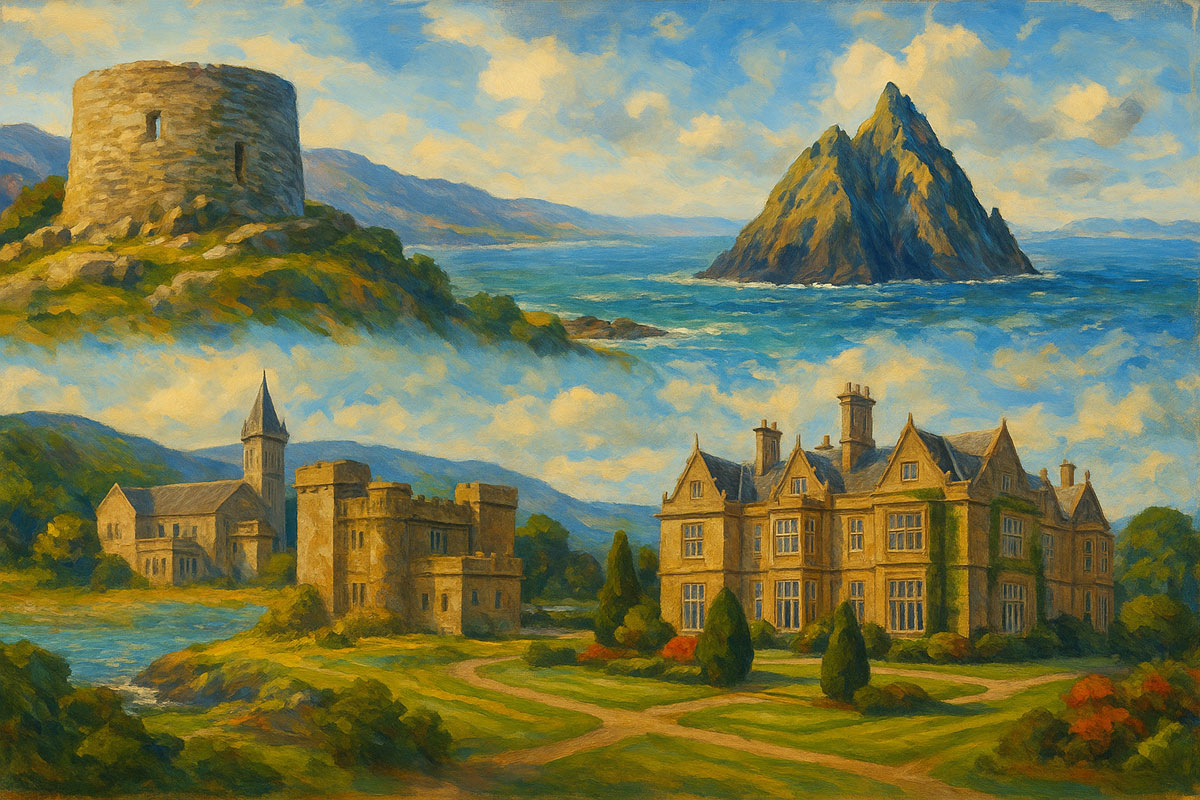

Explore Ireland’s most iconic scenic drive through a lens of heritage, myth, and memory. From ancient stone forts to famine cottages, the Ring of Kerry is a journey into Ireland’s soul.
Table of Contents
- Introduction: A Journey Through Time and Landscape
- Cahersiveen and the Legacy of Daniel O’Connell
- Skellig Ring and the Monastic Marvel of Skellig Michael
- Killarney National Park: Nature, Nobility, and History
A Journey Through Time and Landscape
The Ring of Kerry is more than a scenic loop around the Iveragh Peninsula — it is a living museum of Irish culture, history, and landscape. Spanning approximately 179 kilometers, this famed route in County Kerry weaves through mountains, coastal cliffs, ancient ruins, and charming villages, offering a tapestry of heritage highlights that continue to captivate visitors from around the world.
While many drive the Ring for its panoramic views, those who take time to stop along the way are rewarded with stories that stretch back to prehistory. Stone forts, early Christian sites, famine-era cottages, and Gaelic traditions all coexist here — making the Ring not just a tourist route but a narrative experience. Each bend in the road, each roadside ruin, speaks of resilience and reverence for the past.
History in Every Mile
The history of the Ring is rooted in the people who carved out a life on this rugged terrain. For thousands of years, inhabitants of the Iveragh Peninsula have left behind traces of their lives — from megalithic tombs to medieval castles. The Ring winds past archaeological wonders like Staigue Fort, one of Ireland’s best-preserved stone forts, believed to have been built in the early centuries AD. These dry-stone enclosures remind us of a time when local chieftains ruled and defended their territories from within thick, circular walls.
Cultural Touchstones
But the Ring of Kerry is not only about ancient history — it’s about how that past continues to shape identity today. Along the route, Gaelic is still spoken in parts of the Gaeltacht, and traditional music thrives in pubs from Sneem to Kenmare. That continuity of language and tradition underscores the enduring spirit of Kerry’s people, even as the world around them changes. Whether it’s storytelling in a village pub or artisan crafts in a roadside studio, the heritage of the Ring is alive and evolving.
Beyond the Bus Tours
Many visitors experience the Ring in a single-day coach trip, but to truly appreciate its depth, a slower pace is best. Spend time walking through the ruins, engaging with local historians, or stepping inside heritage centers like the Kerry Bog Village Museum. These stops illuminate the lives of ordinary people — farmers, weavers, and fishermen — whose stories are as vital as those of kings and saints.
Myth and Memory
Like much of Ireland, the Ring of Kerry is steeped in legend. Folklore speaks of giants, warrior queens, and holy monks who shaped the land and left their mark in place names and local lore. These myths are not just fanciful stories — they reflect the deep connection between the Irish people and their landscape. When you stand on a windswept cliff or walk among stone ruins, the past doesn’t feel distant — it feels present.
Cahersiveen and the Legacy of Daniel O’Connell
Located along the northern edge of the Ring of Kerry, the town of Cahersiveen is often called the gateway to Kerry’s political and cultural history. Nestled between the dramatic mountains and the sea, this vibrant town is best known as the birthplace of Daniel O’Connell, one of Ireland’s most influential political figures. Known as “The Liberator,” O’Connell led the campaign for Catholic emancipation in the 19th century and remains a towering figure in Irish heritage.
The Daniel O’Connell Memorial Church
Dominating the skyline of Cahersiveen is the Daniel O’Connell Memorial Church — a truly unique building, as it is the only Catholic church in Ireland dedicated to a layperson. Built in the Gothic Revival style and completed in 1902, the church stands as a striking tribute to O’Connell’s impact on Irish religious and civil rights. With its beautiful stained glass, carved stonework, and scenic location, it’s both a spiritual space and a historical monument.
Old Barracks Heritage Centre
Just a short walk from the church is the Old Barracks Heritage Centre, another landmark that draws history lovers to Cahersiveen. The building itself, resembling a miniature castle with turrets and battlements, dates to the late 1800s. Once a Royal Irish Constabulary barracks, it now houses a museum that traces the story of the region, from prehistoric settlements and Viking invasions to the life of Daniel O’Connell and the Great Famine. Exhibits include local artifacts, storytelling panels, and insights into everyday rural life in Kerry over the centuries.
Ancient Ringforts: Cahergall and Leacanabuaile
History in Cahersiveen isn’t limited to the town center. Just a few kilometers away are two of Ireland’s most impressive stone forts — Cahergall and Leacanabuaile. These early medieval ringforts are beautifully preserved examples of dry-stone architecture, with thick circular walls rising up to three meters in height. Walking through these sites offers an evocative glimpse into Ireland’s past, when families lived inside these protective enclosures, tending their animals and watching for threats from land and sea.
The Legacy Lives On
Cahersiveen may be small in size, but its contributions to Irish history are enormous. From its connection to the struggle for Catholic rights to its proximity to ancient ringforts, the town offers an ideal blend of political, religious, and archaeological significance. It’s also a vibrant place to stop for food, crafts, and conversation, making it a cultural as well as historical highlight along the Ring of Kerry.
Next Stop: The Skellig Ring
From Cahersiveen, many travelers take a short detour off the main Ring to explore the Skellig Ring, a dramatic coastal loop that offers even more historical depth and scenic beauty. We will now visit the monastic marvel of Skellig Michael — a UNESCO World Heritage Site and one of the most awe-inspiring heritage sites in all of Ireland.
Skellig Ring and the Monastic Marvel of Skellig Michael
Just southwest of Cahersiveen lies the Skellig Ring, a lesser-traveled but immensely rewarding extension of the Ring of Kerry. This rugged coastal loop stretches from Waterville to Portmagee and onto Valentia Island, offering jaw-dropping Atlantic views, winding cliffside roads, and the gateway to one of Ireland’s greatest heritage treasures: Skellig Michael.
Skellig Michael: A Monastic World Apart
Rising dramatically from the Atlantic Ocean, about 12 kilometers off the coast, Skellig Michael is one of Ireland’s most awe-inspiring landmarks. Designated a UNESCO World Heritage Site, this jagged rock was home to a community of early Christian monks who established a monastic settlement there sometime between the 6th and 8th centuries.
The monks lived in stone “beehive” huts, or clocháin, built entirely without mortar. They led lives of prayer, manual labor, and isolation, braving the harsh Atlantic elements in pursuit of spiritual closeness to God. The remains of their monastery — including a church, graveyard, and oratories — are incredibly well preserved, and accessible to visitors today via a steep climb of over 600 ancient stone steps.
Portmagee: The Departure Point
The charming fishing village of Portmagee serves as the departure point for boat trips to Skellig Michael, usually available from late spring to early autumn (weather permitting). The town itself is worth exploring, with its colorful buildings, harbor views, and the excellent Skellig Experience Visitor Centre located just across the bridge on Valentia Island. The center offers detailed exhibits on the monastic life, the island’s bird colonies, and its cinematic fame.
Modern Fame Meets Ancient Silence
Skellig Michael gained worldwide attention when it was featured in the Star Wars sequel trilogy as the location of Luke Skywalker’s exile. While this brought global interest to the island, it has not diminished its spiritual or historical significance. Visitors consistently remark on the profound silence and mystical atmosphere that surrounds the ancient site.
Valentia Island: A Hidden Gem
Accessible via bridge from Portmagee, Valentia Island is another heritage highlight. It is home to the Valentia Slate Quarry, which supplied materials for London’s Houses of Parliament, and the transatlantic cable station — where the first successful telegraph connection between Europe and North America was made in 1866. The island’s tetrapod trackway, a 385-million-year-old fossilized footprint, is one of the oldest known records of vertebrate life moving on land.
Skellig: A Place of Pilgrimage
Whether you see Skellig Michael up close on a boat trip or admire it from the coast, it leaves a lasting impression. It is a site that connects Ireland’s early Christian past to the present, where pilgrims, historians, and film fans alike find meaning in its stark beauty and solitude. The Skellig Ring may be a detour from the main route, but it is without a doubt a spiritual and historical high point of any journey around the Ring of Kerry.
Next Stop: Killarney National Park
As we conclude our exploration of the rugged Skellig coast, we return inland to one of Ireland’s most famous natural and historical destinations: Killarney National Park. Let’s now explore noble estates, medieval ruins, and the landscapes that have enchanted poets and patriots alike.
Killarney National Park – Nature, Nobility, and History
No journey around the Ring of Kerry is complete without a visit to Killarney National Park — a place where natural beauty and cultural heritage exist in perfect harmony. As Ireland’s first national park, established in 1932, it encompasses over 26,000 acres of mountains, lakes, woodlands, and waterfalls. But beyond its stunning vistas, Killarney is steeped in layers of Irish history, from medieval monasteries to aristocratic estates.
Muckross House and Gardens
At the heart of the park lies the magnificent Muckross House, a 19th-century Victorian mansion set against the backdrop of Lough Leane. Built in 1843, the estate was famously visited by Queen Victoria in 1861. The interior is beautifully preserved, offering a glimpse into the lifestyle of the landed gentry, while the gardens and traditional farms bring the region’s rural heritage to life.
Adjacent to the house is the Muckross Traditional Farms attraction, where costumed guides demonstrate historical crafts, farming techniques, and domestic life from 1930s rural Ireland. Visitors can walk through old-style thatched cottages, meet working animals, and even sample traditional Irish brown bread baked over an open fire.
Ross Castle and the Lakes of Killarney
Another must-see site within the park is Ross Castle, a 15th-century stronghold that once belonged to the O’Donoghue clan. Set on the shores of Lough Leane, the castle is steeped in legend and lore. According to local myth, the ghost of O’Donoghue sleeps beneath the waters and rises once every seven years on a white horse. Today, guided tours of the castle offer insights into medieval Irish life, clan warfare, and English conquest.
From the castle, boat trips across the Lakes of Killarney provide an unforgettable way to explore the park. The tranquil waters, surrounded by forested mountains and open skies, make it clear why this area has inspired poets and painters for generations.
Torc Waterfall and the Kerry Way
For lovers of outdoor heritage, Torc Waterfall is another highlight. Just a short walk from the road, this 20-meter cascade is fed by the Owengarriff River and surrounded by lush oak woods. It is also part of the Kerry Way, a long-distance walking trail that loops around the Iveragh Peninsula, allowing hikers to retrace much of the Ring of Kerry on foot and discover its quiet, lesser-known corners.
Preserving the Past and Present
Killarney National Park is not just a place of preservation, but of active cultural engagement. Ongoing conservation efforts protect rare species like the red deer, while events and educational programs keep Irish traditions alive for new generations. Whether you’re admiring a grand stately home, wandering through ancient woodland, or listening to local folklore, Killarney offers a holistic heritage experience.
Conclusion: A Ring of Riches
The Ring of Kerry is more than a road trip — it’s a pilgrimage through Ireland’s soul. From prehistoric forts and monastic islands to revolutionary towns and natural sanctuaries, every stop reveals a story. It’s a route where history is not confined to museums, but etched into the stones, songs, and spirits of the land. Whether you’re a first-time visitor or a seasoned traveler, the Ring of Kerry offers something timeless: a connection to Ireland’s enduring heart.