



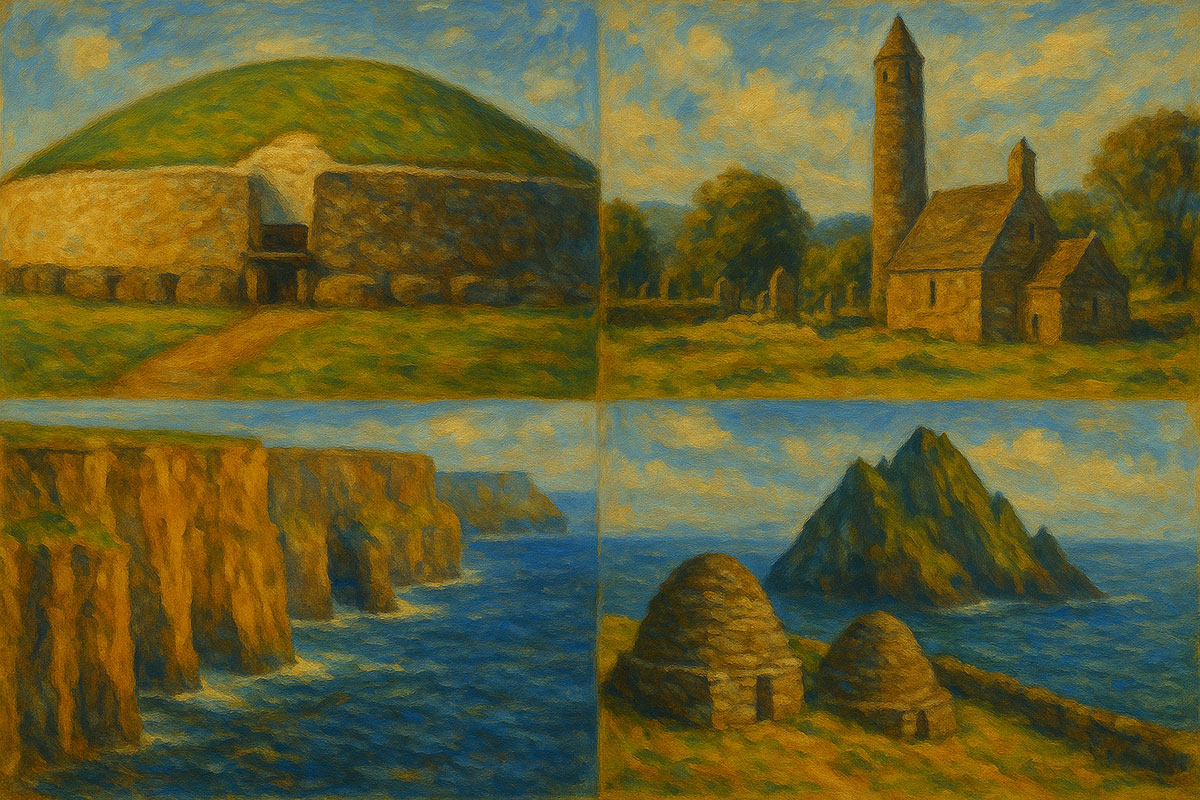

From ancient passage tombs to awe-inspiring natural landscapes, Ireland’s UNESCO World Heritage Sites are living chapters of human history and geological wonder.
Table of Contents
- Brú na Bóinne – The Neolithic Passage Tombs of Newgrange, Knowth, and Dowth
- Skellig Michael – Monastic Outpost on the Edge of the Atlantic
- The Giant’s Causeway – Nature’s Basalt Masterpiece
- Preserving the Past – Challenges and Conservation Efforts
Brú na Bóinne – The Neolithic Passage Tombs of Newgrange, Knowth, and Dowth
Nestled in the lush Boyne Valley of County Meath, Brú na Bóinne is one of the world’s most significant prehistoric landscapes. This UNESCO World Heritage Site, inscribed in 1993, encompasses over 90 Neolithic monuments, with the most famous being Newgrange, Knowth, and Dowth. These passage tombs date back more than 5,000 years—older than Stonehenge and the Great Pyramids of Giza—making them a remarkable testament to early human ingenuity, spirituality, and social organization.
The Timeless Wonder of Newgrange
Newgrange is perhaps the most celebrated of the three tombs, known for its extraordinary winter solstice alignment. Every year around December 21st, a narrow beam of sunlight pierces through a roofbox above the entrance and illuminates the inner chamber—a feat of engineering and astronomical precision achieved by people who had no modern tools. This phenomenon draws thousands of visitors and is a symbol of renewal, marking the rebirth of the sun in the depths of winter.
The structure itself is an architectural marvel: a large circular mound over 80 meters in diameter, encircled by kerbstones adorned with intricate Neolithic carvings. Spirals, lozenges, and concentric circles decorate these stones, offering tantalizing glimpses into the symbolic world of Ireland’s ancient inhabitants.
Knowth – Home to Megalithic Art
Knowth is equally impressive, comprising one large mound surrounded by 17 smaller satellite tombs. It is renowned for having the largest collection of megalithic art in Western Europe—over 300 decorated stones featuring a variety of abstract motifs. While the meaning of these symbols remains a mystery, they reveal the deep cultural and ceremonial significance of the site.
Excavations at Knowth have uncovered evidence of continuous use over millennia, from the Neolithic period through the Iron Age and into the early Christian era, showing how sacred spaces evolved alongside Ireland’s shifting societies.
Dowth – The Quiet Giant
Dowth, less developed for tourism than Newgrange or Knowth, retains a sense of mystery and solitude. Its name comes from the Irish “Dubhadh,” meaning “darkness,” linked to a myth where the sun stood still as part of a magical curse. Though its passage alignment is less well known, Dowth also features impressive megalithic art and a rich archaeological record, offering an atmospheric experience for those seeking a quieter connection with the past.
Visiting Brú na Bóinne
Access to Newgrange and Knowth is via the Brú na Bóinne Visitor Centre, where guided tours provide essential historical context. The centre’s interactive exhibits help visitors appreciate the astronomical alignments, construction techniques, and cultural importance of these tombs. Visiting during winter solstice season is a unique experience, though places for the chamber viewing are allocated via a lottery due to high demand.
Why It Matters
Brú na Bóinne is more than an archaeological site—it’s a bridge to a world where life revolved around the rhythms of the earth and sky. Its preservation offers insights into our shared human past, reminding us of the creativity, spirituality, and determination of Ireland’s earliest farmers and builders. Standing inside a tomb lit by the same sun that illuminated it 5,000 years ago is a humbling reminder of humanity’s enduring connection to nature and the cosmos.
Skellig Michael – Monastic Outpost on the Edge of the Atlantic
Rising dramatically from the Atlantic Ocean off the coast of County Kerry, Skellig Michael is a UNESCO World Heritage Site that seems to belong more to myth than reality. This rugged island, part of the Skellig Islands group, is renowned for its remarkably well-preserved early medieval monastic settlement and its otherworldly natural beauty. Designated a World Heritage Site in 1996, Skellig Michael offers a rare glimpse into Ireland’s early Christian past and its monastic traditions of isolation, prayer, and devotion.
A Monastery at the World’s Edge
Founded between the 6th and 8th centuries, the monastery on Skellig Michael was home to a small community of monks who sought spiritual closeness to God through solitude and austerity. Perched high on a steep slope, the monastery’s stone beehive huts, or clocháns, are ingeniously built without mortar, their dry-stone construction allowing them to withstand centuries of wind and rain.
The monks led an ascetic life, dedicating their days to prayer, scripture study, and tending small gardens for sustenance. The isolation was extreme—the island is accessible only by boat, and rough seas often cut it off from the mainland for weeks at a time.
Architecture and Spiritual Design
The settlement includes six beehive huts, two oratories, stone crosses, and a sophisticated system of terraces and retaining walls. The structures are arranged with an awareness of both practicality and spiritual symbolism, orienting sacred spaces toward the rising sun and the ocean horizon. The craftsmanship reflects a blend of local building traditions and early Christian influences from Europe.
Wildlife and Natural Beauty
Beyond its history, Skellig Michael is a haven for seabirds. During breeding season, the cliffs teem with puffins, gannets, kittiwakes, and storm petrels. The island’s sheer cliffs and green slopes offer breathtaking views, while the surrounding waters are often visited by dolphins and seals, adding to the sense of untamed beauty.
Modern Recognition and Pop Culture
While the site has long been cherished by historians and pilgrims, it gained global attention when it appeared as Luke Skywalker’s secluded hideout in the Star Wars sequel trilogy. This cinematic exposure introduced Skellig Michael to a worldwide audience, though it also raised concerns about balancing tourism with preservation.
Visiting Skellig Michael
Access to the island is strictly controlled to protect its fragile ecosystem and archaeological remains. Licensed boat tours operate seasonally, generally between May and September, and visitor numbers are capped. The landing involves a challenging climb of over 600 stone steps with no handrails, making the journey both physically demanding and spiritually rewarding. Weather can be unpredictable, and trips are often cancelled for safety reasons.
Why It Matters
Skellig Michael embodies the Irish monastic ideal—remote, self-sufficient, and entirely devoted to spiritual life. Standing among its ancient stones with the vast Atlantic stretching endlessly before you, it’s easy to imagine the monks who once called this place home, their prayers mingling with the wind and waves. Its preservation allows future generations to witness a rare and powerful expression of faith, endurance, and harmony with nature.
The Giant’s Causeway – Nature’s Basalt Masterpiece
On the rugged coast of County Antrim in Northern Ireland lies one of the world’s most extraordinary natural formations: The Giant’s Causeway. This UNESCO World Heritage Site, inscribed in 1986, is famed for its 40,000 interlocking basalt columns, formed by volcanic activity some 60 million years ago. With its striking geometric shapes and dramatic setting, the Giant’s Causeway is both a geological marvel and a cultural icon steeped in Irish legend.
A Geological Wonder
The Causeway was created during a period of intense volcanic activity when molten basalt was forced through chalk beds, cooling rapidly and contracting into polygonal shapes. Most columns are hexagonal, though some have four, five, or seven sides. The symmetry and precision of these formations seem almost man-made, a fact that has inspired myths and wonder for centuries.
The area also features unique geological structures such as the “Giant’s Boot,” the “Organ Pipes,” and the “Chimney Stacks,” each formed by the same natural forces yet offering distinctive shapes and stories.
Myths and Legends
According to Irish folklore, the Causeway was built by the giant Fionn mac Cumhaill (Finn McCool) as a bridge to Scotland to face his rival, the Scottish giant Benandonner. When Fionn realized his opponent was far larger than expected, he retreated, and his clever wife disguised him as a baby. Seeing the “baby’s” size, Benandonner fled in fear, tearing up the causeway behind him. This tale remains one of Ireland’s best-loved legends, blending natural wonder with storytelling magic.
Wildlife and Coastal Beauty
The Giant’s Causeway is part of a larger designated Area of Outstanding Natural Beauty, home to seabirds like fulmars, petrels, and guillemots. The surrounding cliffs and headlands offer sweeping ocean views, with walking trails that allow visitors to explore the coastal landscape at their own pace.
Visitor Experience
The Giant’s Causeway Visitor Centre, operated by the National Trust, provides interactive exhibits on the site’s geology, history, and folklore. From there, visitors can take a short walk or a shuttle bus to the stones themselves. Sturdy footwear is recommended, as the basalt can be slippery, especially in wet weather.
For those seeking a more immersive experience, the surrounding area offers cliff-top walking routes such as the Causeway Coast Way, connecting the site to other scenic gems along Northern Ireland’s north coast.
Why It Matters
The Giant’s Causeway is a testament to the immense power of natural forces and the human capacity to weave them into story and meaning. It stands as a bridge between science and legend, offering visitors a chance to marvel at nature’s artistry while feeling a connection to Ireland’s rich cultural heritage. Whether you come for the geology, the myth, or the view, the Causeway leaves an indelible impression.
Preserving the Past – Challenges and Conservation Efforts
Ireland’s UNESCO World Heritage Sites—Brú na Bóinne, Skellig Michael, and the Giant’s Causeway—are irreplaceable treasures. They connect us to human history, geological processes, and cultural identity. But preserving them for future generations is no simple task. Environmental pressures, tourism demand, and the passage of time all present challenges that require careful and ongoing management.
Balancing Tourism and Protection
These sites attract hundreds of thousands of visitors each year, drawn by their beauty and historical significance. While tourism provides crucial economic support for local communities, it also brings risks. Overcrowding can lead to erosion, physical damage to monuments, and disruption of fragile ecosystems.
To address this, strict visitor controls are in place. Skellig Michael, for instance, limits landings to a small number per day during a short summer season. Brú na Bóinne manages access to Newgrange and Knowth exclusively through guided tours from the visitor centre. The Giant’s Causeway uses designated walking paths to protect its basalt formations while still allowing close-up views.
Environmental Threats
Climate change poses an emerging challenge. Rising sea levels, stronger storms, and changing weather patterns threaten coastal sites like Skellig Michael and the Giant’s Causeway. Increased rainfall and temperature changes can also accelerate the deterioration of ancient stonework at Brú na Bóinne.
Conservation teams work continuously to monitor conditions, repair damage, and adapt preservation techniques to new environmental realities. This includes advanced weatherproofing methods, erosion control, and careful vegetation management.
Community Involvement and Education
Local communities play a crucial role in safeguarding these sites. Education programs, volunteer initiatives, and cultural festivals help foster a sense of pride and shared responsibility. Schools often incorporate site visits and heritage lessons, ensuring that younger generations understand the importance of protection and respect.
For example, annual events in the Boyne Valley celebrate solstice traditions at Newgrange, blending tourism with cultural education. In Northern Ireland, interpretive guides at the Giant’s Causeway share both geological facts and local legends, keeping heritage alive through storytelling.
International Collaboration
As UNESCO World Heritage Sites, these landmarks benefit from global expertise. Ireland works with international conservation bodies to share best practices, conduct research, and secure funding for long-term preservation projects. This collaborative approach ensures that lessons learned in Ireland can help protect heritage sites worldwide—and vice versa.
Why Preservation Matters
Preserving these sites is about more than protecting stones, cliffs, and ruins—it’s about safeguarding the stories they tell. They are living links to the ingenuity, beliefs, and artistry of those who came before us. They inspire wonder, humility, and connection across generations and cultures.
When we stand inside Newgrange’s illuminated chamber, atop Skellig Michael’s stone steps, or among the Giant’s Causeway’s basalt columns, we are not just visitors. We are stewards, entrusted with ensuring that these wonders endure so that centuries from now, others may feel the same awe that we do today.
Conclusion
Ireland’s UNESCO World Heritage Sites are timeless gifts—formed by the forces of nature, shaped by human hands, and preserved through collective effort. By valuing and protecting them, we honor both our past and our future, ensuring that these remarkable places continue to inspire and educate for generations to come.
These ancient landscapes reflect early Irish food traditions — learn more at IrishFoodHub.com.
Placement: Final section.