



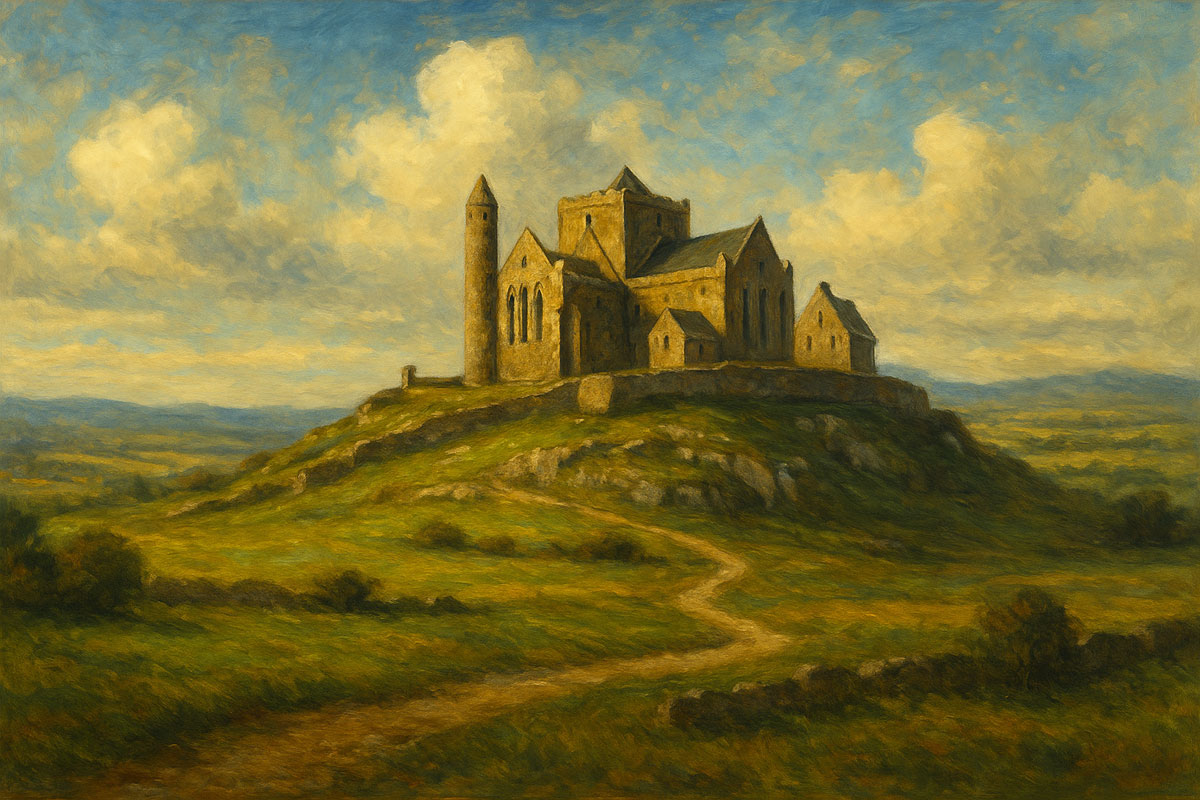

The Rock of Cashel, also known as St. Patrick’s Rock, rises dramatically above the plains of County Tipperary. With its iconic silhouette of medieval towers and Gothic spires, this historic site embodies centuries of Irish power, faith, and legend. Once the seat of kings and later a hub of ecclesiastical authority, the Rock of Cashel remains one of Ireland’s most important heritage landmarks.
Table of Contents
- The Royal Origins of the Rock of Cashel
- Architectural Marvels: From Cormac’s Chapel to the Gothic Cathedral
- The Religious Legacy and St. Patrick’s Influence
- The Rock of Cashel Today: Preservation and Tourism
The Royal Origins of the Rock of Cashel
The story of the Rock of Cashel begins long before its medieval buildings were constructed. This limestone outcrop was a natural stronghold, rising 200 feet above the surrounding Golden Vale, and its commanding position made it a perfect seat of power. For centuries, Cashel was associated with the kings of Munster, who ruled much of southern Ireland. Its name is derived from the Gaelic word Caiseal, meaning “stone fort,” reflecting its role as both a royal fortress and a symbol of authority.
The Seat of the Kings of Munster
According to tradition, the Rock of Cashel became the seat of the Eóganachta dynasty, who ruled Munster from around the 4th century. From this vantage point, they controlled the fertile lands of the Golden Vale, ensuring prosperity and influence. Cashel was not just a political center but also a cultural one, where laws were declared, alliances forged, and ceremonies held. It became synonymous with royal power in Ireland’s early medieval period.
Legends of St. Patrick and King Aengus
One of the most famous legends tied to Cashel is its connection with St. Patrick, Ireland’s patron saint. Around the 5th century, Patrick is said to have converted King Aengus of Munster to Christianity at the Rock of Cashel. According to the story, during the baptism ceremony, Patrick accidentally pierced the king’s foot with his crosier. Believing it to be part of the ritual, Aengus endured the pain in silence, a testament to his faith and commitment. This tale symbolizes the union of royal and religious authority that would define Cashel’s history.
Transition from Royal to Ecclesiastical Power
By the 10th century, the Rock of Cashel’s role as a royal stronghold began to shift. In 1101, King Muirchertach O’Brien, ruler of Munster, formally gifted the Rock to the Church. This moment marked the transition from a seat of kings to a center of ecclesiastical power. It also reflected the growing influence of the Church in Ireland, as Cashel became the site of major synods and religious reforms.
Strategic and Symbolic Importance
The Rock’s elevated position made it a strategic location, but its symbolic significance was even greater. For centuries, it represented the unity of political and spiritual power in Munster. Kings were crowned at Cashel, and later, archbishops presided over religious life from its summit. Its stone walls, visible for miles, became a beacon of authority, faith, and identity for the Irish people.
Why the Royal Origins Matter
Understanding the Rock of Cashel’s royal origins provides essential context for its later development as a religious site. Its transformation from a fortress of kings to a citadel of the Church illustrates Ireland’s dynamic history, where politics, faith, and legend intertwine. The Rock of Cashel was not just a fortress or a cathedral—it was a stage where the drama of Irish history unfolded, shaping the nation’s identity for centuries to come.
Architectural Marvels – From Cormac’s Chapel to the Gothic Cathedral
The Rock of Cashel is not only a place of history and legend—it is also a showcase of Ireland’s finest medieval architecture. The site contains a collection of remarkable buildings spanning centuries, each telling a story of shifting styles, influences, and purposes. From Romanesque artistry to soaring Gothic design, the structures on the Rock embody both the spiritual devotion and the creative skill of the generations who built them.
The Round Tower
The oldest surviving structure on the Rock is the round tower, dating from around 1100 AD. Rising nearly 28 meters, the tower was constructed from sandstone and limestone without the use of mortar, a testament to the precision of early Irish builders. Round towers were typically used as bell towers and places of refuge during Viking raids, and Cashel’s tower symbolizes the enduring strength of Ireland’s ecclesiastical communities. Its commanding presence sets the tone for the entire site.
Cormac’s Chapel
Perhaps the most celebrated building on the Rock is Cormac’s Chapel, consecrated in 1134. Commissioned by King Cormac Mac Carthaigh, it is one of the finest examples of Romanesque architecture in Ireland. Its stonework features intricate carvings, arched doorways, and decorative capitals influenced by continental Europe, reflecting Ireland’s connections with the wider Christian world. Inside, faint traces of 12th-century frescoes can still be seen, making it one of the few surviving examples of medieval wall painting in Ireland.
The Cathedral
Dominating the Rock’s skyline is the Gothic cathedral, built between 1235 and 1270. This vast, cruciform church replaced earlier structures and became the centerpiece of Cashel’s ecclesiastical authority. Its high vaulted ceilings, lancet windows, and massive walls demonstrate the Gothic style at its peak. Though roofless today, the cathedral’s soaring stonework still evokes a sense of grandeur and sacredness. For centuries, it was the site of important ceremonies, synods, and religious life in Munster.
The Hall of the Vicars Choral
Built in the 15th century, the Hall of the Vicars Choral housed the clergy who served the cathedral’s liturgy. Restored in the 1970s, it now contains a small museum showcasing artifacts from the Rock, including original carvings and medieval relics. The hall adds a human dimension to the monumental architecture, reminding visitors of the daily lives of the men who kept worship alive within these sacred walls.
Defensive Walls and Gatehouses
Surrounding the Rock are defensive walls and gatehouses that reflect its dual role as a place of both sanctuary and protection. These fortifications highlight the turbulence of medieval Ireland, when churches often served not only as places of prayer but also as refuges against conflict. The Rock’s commanding position meant that its defenses were as symbolic as they were practical, underlining its authority over the surrounding countryside.
A Fusion of Styles and Eras
Together, the buildings of the Rock of Cashel illustrate a fusion of Irish, Romanesque, and Gothic traditions. Each structure marks a different phase in Ireland’s history—from early medieval monasticism to the flourishing of high medieval ecclesiastical power. Walking among them, visitors experience centuries of craftsmanship and devotion layered upon a single limestone outcrop.
Why the Architecture Matters
The architectural marvels of the Rock of Cashel are more than ruins—they are living testimonies to Ireland’s cultural and spiritual evolution. They reveal the ambitions of kings and bishops, the artistry of medieval masons, and the enduring importance of faith in Irish life. For historians, architects, and pilgrims alike, the Rock stands as one of the most complete and inspiring medieval ensembles in Europe.
The Religious Legacy and St. Patrick’s Influence
The Rock of Cashel is not only a royal and architectural treasure—it is also one of Ireland’s most sacred religious sites. For centuries, it has been a place of worship, pilgrimage, and spiritual authority, closely tied to Ireland’s patron saint, St. Patrick. Its role in spreading Christianity and shaping Ireland’s religious identity cannot be overstated.
St. Patrick and the Baptism of King Aengus
One of the most enduring legends associated with the Rock of Cashel is the baptism of King Aengus of Munster by St. Patrick in the 5th century. According to tradition, during the ceremony, Patrick accidentally drove his crosier into the king’s foot. Mistaking the pain as part of the ritual, Aengus endured it in silence, a symbol of faith and sacrifice. This event marked the Rock as a cornerstone of Ireland’s Christian heritage, blending royal power with the authority of the Church.
Cashel as an Ecclesiastical Powerhouse
After King Muirchertach O’Brien gifted the Rock to the Church in 1101, it became the ecclesiastical capital of Munster. Major synods, such as the Synod of Cashel in 1172, were held here, shaping Ireland’s religious and political landscape. The site became the seat of archbishops and a hub of reform, aligning Irish Christianity more closely with Rome. From this elevated outcrop, the Church projected both spiritual and administrative power across southern Ireland.
Pilgrimage and Devotion
For centuries, the Rock of Cashel has drawn pilgrims seeking a deeper connection with Ireland’s Christian past. The beehive huts, crosses, and chapels that dot the site are reminders of the devotion practiced here. Even today, visitors describe a sense of reverence as they walk among the ruins, surrounded by the echoes of prayer and ritual that once filled the cathedral and chapel walls.
The Role of the Synods
The Synod of Cashel in 1172, held shortly after the arrival of the Normans in Ireland, was particularly significant. It sought to reform the Irish Church, bringing it in line with Roman practices and consolidating the influence of both Church and Crown. These synods highlight Cashel’s role not just as a local religious center but as a stage for decisions that shaped the course of Irish Christianity.
Symbol of Faith in Turbulent Times
Throughout its history, the Rock of Cashel has also been a symbol of resilience. Even during times of upheaval—such as the Cromwellian wars in the 17th century, when many were massacred on its grounds—the Rock remained a beacon of faith. Its ruins are not merely relics of destruction but reminders of the endurance of belief in the face of adversity.
Why the Religious Legacy Matters
The Rock of Cashel’s religious legacy is central to its identity. It stands at the intersection of legend and history, where St. Patrick’s mission, medieval synods, and centuries of worship converge. To visit Cashel is to walk in the footsteps of saints, kings, and pilgrims, experiencing firsthand a site where Ireland’s spiritual heritage has been preserved for more than 1,500 years.
The Rock of Cashel Today – Preservation and Tourism
Today, the Rock of Cashel stands as one of Ireland’s most visited and admired heritage sites. Its dramatic silhouette, perched high above the Golden Vale, continues to capture the imagination of travelers, historians, and pilgrims alike. More than a ruin, the Rock is a living monument—carefully preserved, interpreted, and celebrated as a cornerstone of Irish history and culture.
Preservation and Conservation Efforts
Centuries of exposure to wind, rain, and storms have taken their toll on the Rock of Cashel. Recognizing its importance, the Irish state and heritage bodies have invested heavily in conservation. Cormac’s Chapel, with its delicate frescoes, has been the focus of major restoration projects to stabilize its structure and protect its rare medieval artwork. Regular maintenance ensures the stonework of the round tower, cathedral, and defensive walls remains intact for future generations. These efforts balance the need for access with the responsibility of safeguarding a fragile site.
A UNESCO Candidate
The Rock of Cashel is currently on Ireland’s tentative list for UNESCO World Heritage status. While not yet officially inscribed, its candidacy highlights its outstanding universal value—both as a royal and religious site. UNESCO recognition would further ensure its protection and enhance its profile as one of the world’s great cultural landmarks.
Tourism and Visitor Experience
Each year, hundreds of thousands of visitors make their way to Cashel to explore the site. The visitor centre provides exhibitions on the Rock’s history, artifacts, and legends, while guided tours bring the stories of kings, saints, and warriors to life. Interpretive panels and multimedia displays help guests connect the ruins with the vibrant history they represent. For many, climbing the Rock and standing amid the cathedral’s soaring ruins is an unforgettable highlight of their Irish journey.
The Rock in the Community
The Rock of Cashel is not only a tourist attraction but also a focal point for the local community. Festivals, cultural events, and religious services continue to take place on and around the site, ensuring that its heritage remains relevant today. The town of Cashel, with its shops, restaurants, and welcoming atmosphere, complements the experience, offering a blend of modern Irish life with echoes of the medieval past.
A Symbol of Irish Identity
For many, the Rock of Cashel symbolizes the enduring spirit of Ireland. Its blend of royal authority, Christian devotion, and artistic achievement encapsulates the nation’s story. Whether viewed from afar across the Golden Vale or explored up close among its stone walls, the Rock serves as a reminder of Ireland’s resilience, creativity, and faith through the ages.
Why Cashel Endures
The Rock of Cashel endures not just because of its architecture or legends but because of the meaning it carries. It represents the meeting of Ireland’s royal and religious traditions, the persistence of heritage in the face of change, and the power of place to inspire. Its continued preservation ensures that future generations will not only learn about Ireland’s past but experience it firsthand.
Conclusion: The Rock of Cashel is truly a pinnacle of Irish heritage. From its origins as the seat of kings to its transformation into a religious stronghold, and from centuries of legend to its role today as a cultural treasure, the Rock continues to shape Ireland’s story. It is a site where history lives on—etched in stone, celebrated in memory, and preserved for the future.