


Elegant, melodic, and deeply symbolic, the harp has long been the emblem of Ireland’s soul. From ancient bards and medieval courts to rebel banners and modern coins, the harp’s story echoes through Irish history as a symbol of identity, resilience, and art.
Table of Contents
- The Ancient Origins of the Irish Harp
- The Harp in Medieval Ireland: Music and Majesty
- The Harp as a National and Political Symbol
- The Harp in Modern Ireland
The Ancient Origins of the Irish Harp
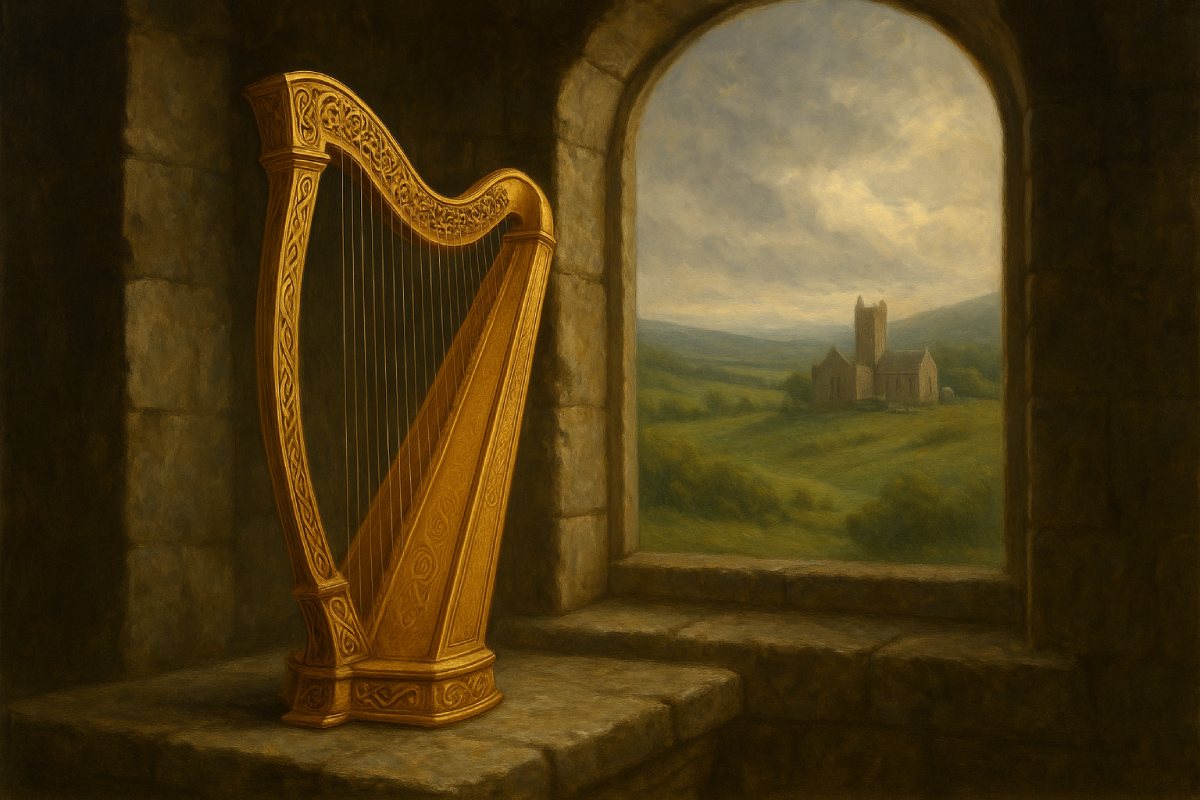
The harp, or cláirseach in Irish, is one of the oldest stringed instruments in Europe. Its presence in Irish legend and art predates written history, making it both a musical instrument and a mythic icon. In ancient tales, harpers were not merely entertainers but keepers of lore, poetry, and the spirit of the people.
Early Irish harps were smaller than modern orchestral versions, crafted from willow or oak with brass or bronze strings that produced a bell-like resonance. They were played by plucking, often using the fingernails, to create music of haunting beauty. The instrument became closely associated with the noble classes and with the tradition of the filí (poet-seers) and ollamhs (chief poets).
According to legend, the harp belonged to Dagda, a god of the ancient Irish pantheon, who used it to command the seasons and stir emotions. His three melodies — joy, sorrow, and sleep — became the foundation of Ireland’s musical soul.
The Harp in Medieval Ireland: Music and Majesty
During the medieval period, the harp became the defining instrument of Gaelic Ireland. Harpers held high social status, serving kings and chieftains as professional musicians and historians. Their songs celebrated victories, recorded genealogies, and preserved oral tradition at a time when much of Europe relied on written records.
Medieval manuscripts, including the Book of Kells, depict angels playing harps, confirming its sacred as well as secular importance. Irish harpers traveled across Europe, admired for their artistry and skill. In fact, the word “harp” became so closely tied to Ireland that foreigners referred to wandering Irish musicians simply as “harpers.”
One of the oldest surviving instruments, the Trinity College Harp — also known as the Brian Boru Harp — dates from the 14th or 15th century. It remains a national treasure, its intricate carvings and brass strings symbolizing both Ireland’s craftsmanship and cultural continuity.
The Harp as a National and Political Symbol
By the 16th century, as English influence expanded, the harp took on a new meaning — one of resistance and identity. When Henry VIII declared himself “King of Ireland” in 1541, he adopted the harp as part of the royal coat of arms to symbolize Ireland under English rule. Ironically, this act solidified the harp’s image as the emblem of the Irish nation itself.
During the 17th and 18th centuries, as native Gaelic culture declined under colonial suppression, the harp became a symbol of defiance. Irish patriots used it on flags, coins, and publications to assert cultural pride. The phrase “Erin Go Bragh” (Ireland Forever) often appeared beside a golden harp on a green field, linking the instrument to Ireland’s struggle for independence.
Harpers themselves suffered during this period. The once-great tradition dwindled as Gaelic courts disappeared, leading to the last great gathering of traditional harpers — the Belfast Harp Festival of 1792. There, Edward Bunting transcribed the music of the remaining masters, preserving melodies that might otherwise have been lost.
As the Irish nationalist movement gained momentum in the 19th century, the harp reemerged as a unifying emblem. It adorned the seals of revolutionary groups and appeared on the flags of the United Irishmen and later the Irish Free State. It was a symbol not of monarchy, but of memory — a reminder of Ireland’s enduring voice.
The Harp in Modern Ireland
Today, the harp remains Ireland’s official national emblem — the only country in the world to feature a musical instrument as its state symbol. It appears on government documents, the presidential seal, and euro coins. The version used by the Irish state is based on the Trinity College Harp, facing left, while the harp of Guinness — Ireland’s famous brewery — faces right, a subtle distinction that reflects both heritage and branding.
The harp also continues to inspire Irish music, both traditional and contemporary. Musicians such as Derek Bell, Máire Ní Chathasaigh, and Clannad have brought the instrument’s ethereal tones to global audiences. In festivals like the O’Carolan Harp Festival in County Meath, modern harpers celebrate the legacy of Turlough O’Carolan, the 18th-century composer who bridged classical and folk traditions.
Beyond music, the harp symbolizes Ireland’s harmony between past and present. It embodies creativity, resilience, and unity — qualities that have carried the Irish spirit through centuries of change.
Conclusion
The harp of Ireland is more than an instrument; it is the sound of a nation’s history. From the halls of kings to the dreams of poets, its strings have carried Ireland’s joys and sorrows across the ages. Whether carved in stone, printed on coins, or played beneath cathedral arches, the harp continues to sing — a timeless melody of Irish identity.