



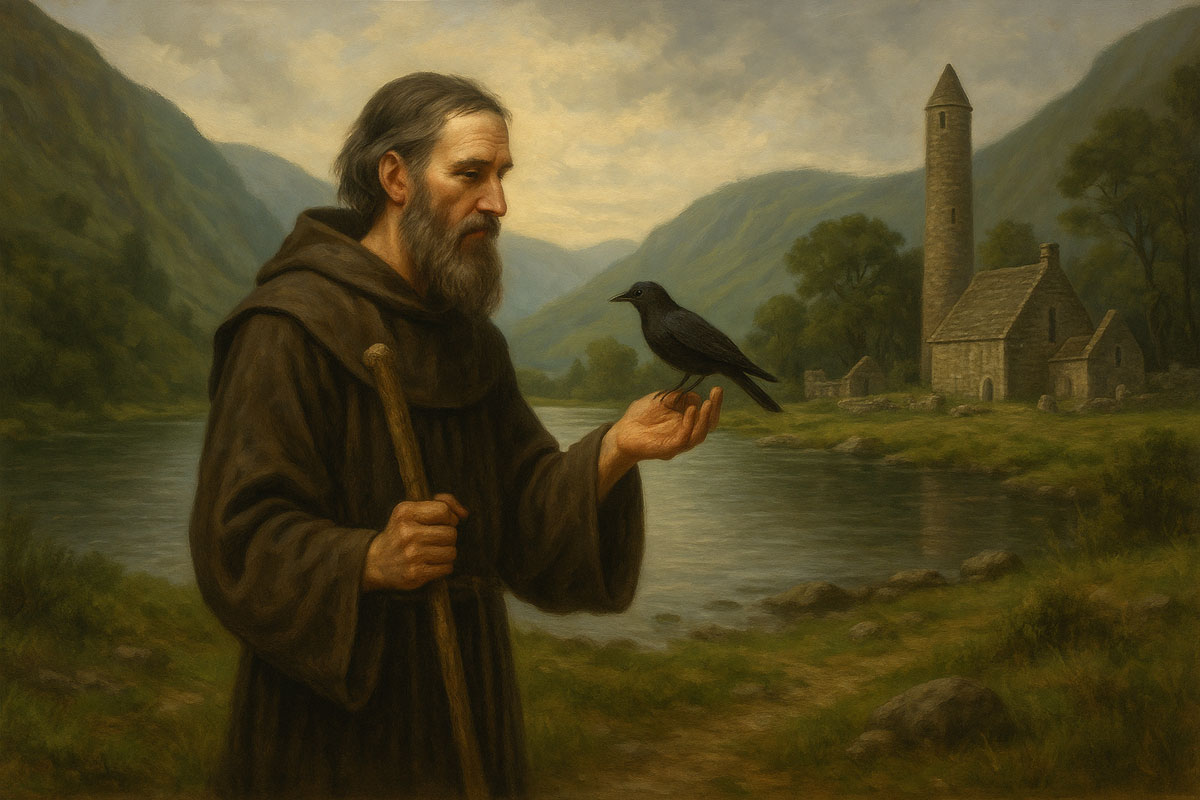

Hidden deep within the Wicklow Mountains lies Glendalough, one of Ireland’s most breathtaking monastic sites. At its heart stands the memory of St. Kevin—hermit, monk, poet, and one of Ireland’s most beloved holy men. His story is woven into the lakes, forests, and stone ruins that still draw pilgrims and seekers from around the world.
Table of Contents
- Kevin’s Early Life: A Call to Solitude
- Glendalough: A Monastic Haven in the Valley of Two Lakes
- Legends and Stories of St. Kevin
- The Enduring Legacy of St. Kevin and Glendalough
Kevin’s Early Life — A Call to Solitude
St. Kevin (Irish: Caoimhín; Old Irish: Coemgen) was born around 498 AD into a noble Leinster family. From a young age, he showed a deep spiritual inclination, preferring prayer, study, and silence over worldly pursuits. He trained under holy men such as St. Petroc and went on to study at prominent early-Christian schools, where he became known for wisdom and gentleness.
Like many early Celtic saints, Kevin felt drawn to solitude—not out of rejection of the world, but as a way to seek deeper intimacy with God. Eventually he withdrew into the remote Wicklow Valley, a wild and rugged landscape of forests, lakes, and mountain slopes. There he lived as a hermit in a small cave now known as “St. Kevin’s Bed,” perched above the Upper Lake.
These early years of ascetic life formed Kevin’s character. He prayed, fasted, studied Scripture, and embraced simplicity. Nature became both his companion and his teacher—a hallmark of early Irish spirituality.
Glendalough — A Monastic Haven in the Valley of Two Lakes
Kevin’s solitude did not last forever. His holiness drew followers who visited the valley seeking instruction and spiritual guidance. Over time, he founded a monastery that grew into one of Ireland’s most important early Christian settlements: Glendalough, meaning “Valley of the Two Lakes.”
Glendalough developed into a thriving monastic community known for:
- Scholarship — monks studied Scripture, copied manuscripts, and preserved learning.
- Hospitality — travelers, pilgrims, and students found refuge in the peaceful valley.
- Architecture — the site eventually included a round tower, stone churches, beehive huts, and hermitages.
- Prayer and contemplation — Kevin’s emphasis on silence shaped the community’s spiritual rhythm.
The monastery became a center of pilgrimage for centuries. Its scenic beauty—mirrored lakes, oak forests, and misty mountains—enhanced its reputation as a place where heaven and earth seemed to touch.
Even after Kevin’s death in 618 AD, Glendalough continued to flourish for hundreds of years, surviving Viking raids, political turmoil, and shifting cultural landscapes. Today, it remains one of Ireland’s most iconic heritage sites.
Legends and Stories of St. Kevin
The life of St. Kevin is rich with stories that blend history, folklore, and spiritual symbolism. These tales reflect Ireland’s deep affection for him and its tradition of seeing holiness in harmony with the natural world.
The Blackbird’s Nest
One of the most beloved legends tells how Kevin stood in prayer with his arms outstretched. A blackbird landed in his hand, built a nest, and laid eggs. Rather than disturb the creature, Kevin remained still until the chicks hatched. This story symbolizes patience, gentleness, and respect for creation.
Kevin and the Animals
Like many Celtic saints, Kevin was said to have a special bond with animals. Stories describe him feeding deer, calming wild beasts, and blessing the valley’s creatures. These legends highlight the harmony between the spiritual life and the natural world—a major theme in early Irish Christianity.
Miracles and Healings
Accounts describe Kevin healing the sick, guiding lost travelers, and offering wise counsel to kings and commoners alike. His presence brought peace, and his prayers were believed to protect the valley.
A Life of Simplicity
Kevin’s sanctity was rooted not in heroic feats, but in humility, prayer, and a life lived close to God. His love of solitude remained central even as he guided a large monastic community.
These stories, whether literal or symbolic, reveal the heart of a man deeply attuned to both the divine and the natural world.
The Enduring Legacy of St. Kevin and Glendalough
St. Kevin’s influence continues to shape Irish spirituality and heritage. Glendalough remains one of the country’s most visited monastic sites, drawing pilgrims, hikers, nature lovers, and those seeking peace.
His legacy includes:
- A model of Celtic monasticism — balancing solitude, scholarship, community, and connection to nature.
- A landscape infused with memory — every stone church, round tower, and forest path echoes his presence.
- Inspiration for poetry and art — Kevin appears in works by Seamus Heaney and other Irish writers.
- A symbol of peace and contemplation — his life encourages stillness in a hurried world.
Visitors to Glendalough often describe a sense of sacred calm—the same serenity Kevin sought in the valley’s quiet beauty. His spirit lives on not only in ancient stone ruins, but in the enduring Irish belief that nature and the divine are never far apart.
Conclusion
St. Kevin of Glendalough stands as one of Ireland’s great spiritual figures—a hermit turned mentor, a poet of nature, and a founder of one of the island’s most beloved monastic valleys. His life calls us to simplicity, reverence, and peace. Whether encountered through legend, landscape, or prayer, Kevin remains a gentle guide whose influence continues to soften hearts and shape Ireland’s sacred imagination.