



The Irish Rebellion of 1798 stands as one of the most dramatic and tragic chapters in Ireland’s history. Driven by ideals of liberty, equality, and national self-determination, ordinary men and women rose against British rule. Their struggle—marked by bravery, hardship, and devastating loss—left a deep imprint on Ireland’s political consciousness and cultural memory.
Table of Contents
- Ireland Before 1798: Oppression and Revolutionary Ideas
- The Outbreak of Rebellion: United Irishmen and Uprising
- Battles, Brutality, and Civilian Suffering
- Legacy of the 1798 Rebellion in Irish History
Ireland Before 1798 — Oppression and Revolutionary Ideas
By the late 18th century, Ireland was a deeply divided society. Political power rested almost entirely in the hands of a Protestant elite loyal to the British Crown, while the majority Catholic population—and many Presbyterians—were excluded from government, land ownership, and basic civil rights under the Penal Laws.
Economic hardship was widespread. Tenant farmers struggled under high rents, tithes to the Anglican Church, and frequent food shortages. Rural resentment simmered, while urban centers buzzed with political debate inspired by the American and French Revolutions.
Out of this climate emerged the Society of United Irishmen, founded in 1791. Its leaders envisioned an Ireland where Catholics, Protestants, and Dissenters could unite as equals, free from sectarian division. Their goal was parliamentary reform—and eventually independence—from British control.
As revolutionary ideas spread, British authorities responded with repression. Militias were armed, homes searched, and suspected rebels imprisoned or tortured. These harsh measures, rather than suppressing unrest, helped push Ireland toward open rebellion.
The Outbreak of Rebellion — United Irishmen and Uprising
The rebellion was originally planned as a coordinated national rising, supported by French military aid. However, British intelligence infiltrated the United Irish leadership, arresting key figures and disrupting plans. When rebellion finally erupted in May 1798, it did so in fragmented and uncoordinated bursts.
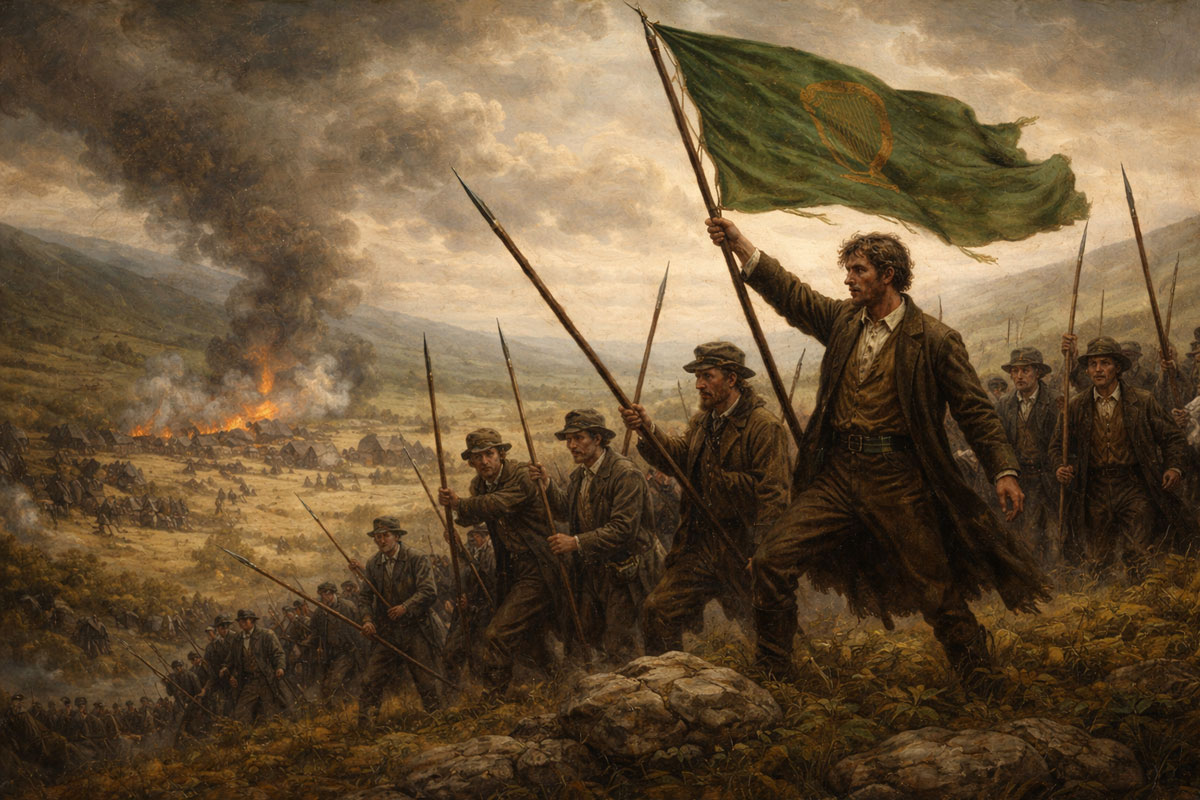
Wexford became the epicenter of the uprising. Poorly armed but deeply determined rebels—many carrying pikes rather than firearms—rose against local garrisons. Initial victories gave hope that change was possible. Ordinary farmers, laborers, artisans, and even women took part, driven by a belief that freedom was worth the risk.
Elsewhere, rebellion flared in parts of Wicklow, Antrim, Down, and Meath. In Ulster, Presbyterian rebels joined the cause, highlighting the cross-community ideal at the heart of the United Irish movement. Yet without strong leadership or consistent external support, the rebels faced overwhelming odds.
French forces did eventually land in Ireland later in the year, but their arrival came too late and in insufficient numbers to turn the tide. The rebellion was already being crushed.
Battles, Brutality, and Civilian Suffering
The 1798 Rebellion was marked by intense violence on all sides. Major engagements, such as the Battle of Vinegar Hill, became symbols of both bravery and tragedy. Thousands of poorly equipped rebels faced disciplined British forces with artillery and cavalry.
The aftermath was devastating. Villages were burned, suspected rebels executed without trial, and civilians caught in cycles of reprisal. Loyalist militias and yeomanry units carried out brutal campaigns, while some rebel groups also committed atrocities, deepening sectarian wounds.
Perhaps the greatest tragedy of 1798 was the human cost. Tens of thousands were killed, wounded, or displaced. Families were torn apart, livelihoods destroyed, and entire regions traumatized. Many leaders were executed or exiled, including prominent figures whose writings and speeches later inspired future generations.
Women played vital but often overlooked roles—as messengers, caregivers, and protectors of families. Their courage, like that of countless unnamed men and women, remains an essential part of the rebellion’s story.
Legacy of the 1798 Rebellion in Irish History
Although the rebellion failed militarily, its impact on Irish history was profound. In the immediate aftermath, Britain passed the Act of Union (1801), abolishing Ireland’s parliament and formally uniting Ireland with Great Britain. While intended to stabilize control, the Act deepened resentment and fueled later nationalist movements.
The ideals of the United Irishmen—unity across religious lines, democratic reform, and national sovereignty—did not die in 1798. Instead, they became foundational principles for future struggles, including the Young Ireland movement, the Fenian Rising, and the Easter Rising of 1916.
In Irish memory, 1798 is remembered not simply as a failed revolt, but as a moment of moral courage. Ballads, poems, and commemorations preserve the voices of those who dared to imagine a different Ireland. Sites across the country still bear the scars and stories of that year.
The rebellion also serves as a cautionary tale—illustrating the devastating consequences of sectarian division, colonial repression, and unchecked violence. Its legacy challenges each generation to reflect on justice, unity, and the true cost of freedom.
Conclusion
The Irish Rebellion of 1798 was a defining moment of courage and sacrifice. Though crushed by superior force, it reshaped Ireland’s political identity and planted seeds that would eventually lead to independence. The men and women of 1798 did not live to see their dream fulfilled, but their bravery ensured that Ireland would never forget the price of liberty—or the power of hope in the face of overwhelming odds.