

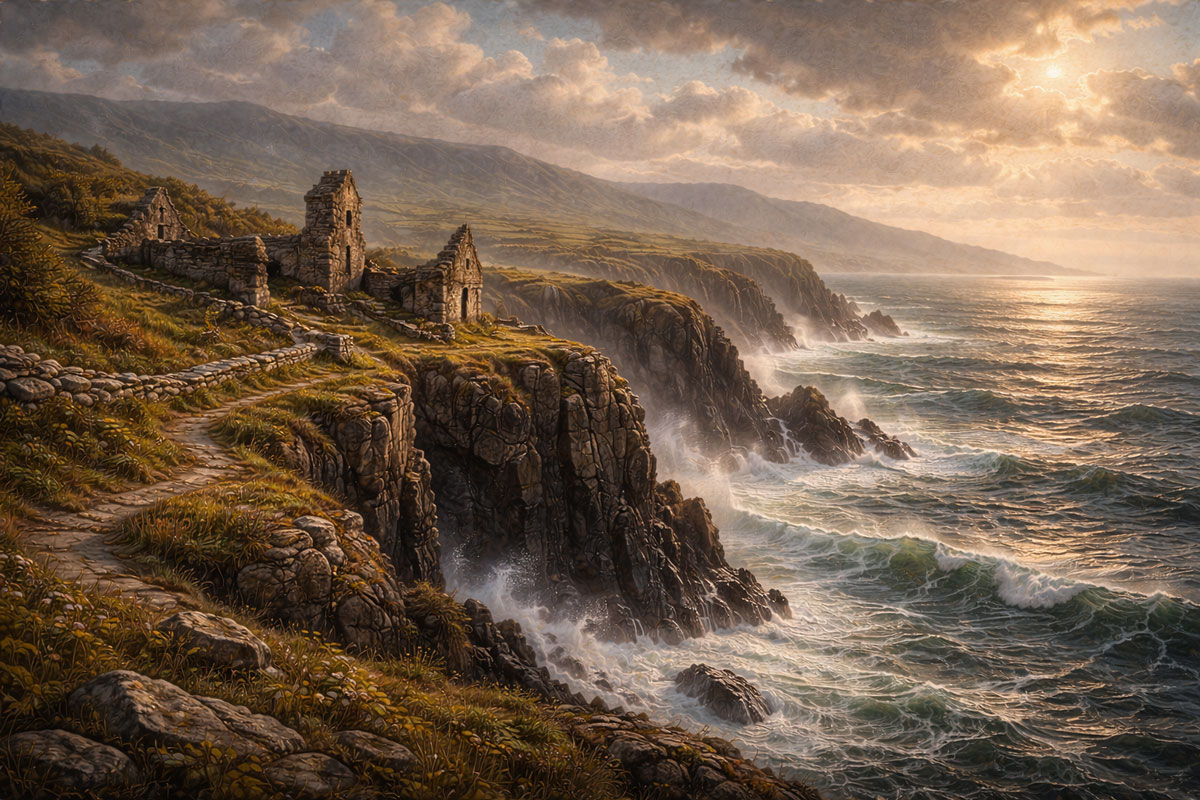

Stretching over 1,500 miles from Donegal to West Cork, the Wild Atlantic Way is one of the world’s longest defined coastal routes. More than a scenic drive, it is a journey through Ireland’s layered past—where prehistoric tombs, early Christian monasteries, medieval castles, and living traditions cling to the edge of the Atlantic. Along this rugged coastline, landscape and heritage are inseparable.
Table of Contents
- The Wild Atlantic Way: A Cultural Journey
- Northern Reaches: Donegal and Mayo
- The Western Heart: Galway and Clare
- Southern Shores: Kerry and Cork
- Living Heritage Along the Atlantic Coast
The Wild Atlantic Way — A Cultural Journey
The Wild Atlantic Way follows Ireland’s western seaboard, tracing a coastline shaped by ocean storms, glacial forces, and thousands of years of human settlement. While the route is celebrated for cliffs, beaches, and dramatic headlands, it is equally rich in heritage.
For millennia, coastal communities relied on the Atlantic for survival and connection. Fishing, farming, pilgrimage, and trade shaped life along the shore. Monks settled on isolated islands, castles guarded harbors, and prehistoric peoples left monuments aligned with sea and sky.
Traveling the Wild Atlantic Way is not simply about moving from place to place—it is about encountering layers of history embedded in stone, language, and landscape.
Northern Reaches — Donegal and Mayo
The northern stretches of the Wild Atlantic Way feel raw and elemental. In County Donegal, ancient heritage meets some of Ireland’s most dramatic scenery.
Sites such as Grianán of Aileach, a massive stone ring fort overlooking Lough Foyle, speak to Ireland’s prehistoric and early medieval past. Though slightly inland, its commanding views connect it symbolically to the Atlantic world beyond.
Along Donegal’s coast, early Christian sites, holy wells, and island settlements reveal a tradition of faith rooted in isolation and endurance. The legacy of St. Columba remains especially strong in this region, linking Donegal spiritually to Scotland and the wider Atlantic.
Further south in County Mayo, heritage sites blend seamlessly with wild coastal landscapes. Céide Fields, one of the world’s oldest known field systems, lies hidden beneath blanket bog near the Atlantic edge. Nearby, ancient promontory forts and abandoned villages recall centuries of settlement and hardship.
Mayo’s coastline also carries strong famine memory, with deserted settlements and emigration points marking the tragic turning points of the 19th century.
The Western Heart — Galway and Clare
Galway and Clare form the cultural heart of the Wild Atlantic Way, where Irish language, music, and tradition remain deeply rooted.
The Aran Islands, rising from Galway Bay, preserve a way of life shaped by stone walls, fishing, and faith. Prehistoric forts such as Dún Aonghasa cling dramatically to cliff edges, reminding visitors that these islands were sacred landscapes long before Christianity arrived.
Monastic ruins, holy wells, and early churches dot the islands, reflecting centuries of devotion and resilience in the face of Atlantic storms.
In County Clare, the Burren presents a unique fusion of geology and heritage. Megalithic tombs such as Poulnabrone Dolmen stand starkly against limestone pavement, evidence of Neolithic communities who lived and worshipped close to the sea.
The Cliffs of Moher, while primarily a natural wonder, also carry cultural significance. They loom near early settlements and trade routes and have inspired generations of poets, artists, and storytellers.
Southern Shores — Kerry and Cork
As the route continues south, heritage becomes increasingly intertwined with monasticism and medieval power.
County Kerry offers some of the most iconic heritage stops along the Wild Atlantic Way. Skellig Michael, rising sharply from the Atlantic, is one of Ireland’s most extraordinary sites. This early Christian monastery, built on near-vertical rock, reflects an intense spiritual commitment shaped by isolation and faith.
On the mainland, the Ring of Kerry passes stone forts, ogham stones, and early churches, all set against dramatic coastal scenery. These monuments reveal how ancient communities adapted to a challenging but resource-rich environment.
In West Cork, the landscape softens, but the heritage remains rich. Coastal towns grew around fishing, trade, and maritime connections. Castle ruins, signal towers, and historic harbors reflect centuries of contact with Europe and beyond.
The region also preserves strong storytelling traditions, linking myth, history, and local identity along the shore.
Living Heritage Along the Atlantic Coast
One of the most distinctive aspects of the Wild Atlantic Way is that its heritage is not confined to ruins and monuments—it is lived every day.
Gaeltacht regions along the coast preserve the Irish language as a living means of communication. Traditional music sessions, storytelling, and festivals remain central to community life.
Fishing practices, boat-building traditions, and coastal farming methods connect modern communities to generations past. Even place names along the route preserve ancient meanings tied to landscape, myth, and memory.
The Atlantic coast has also shaped a particular worldview—one marked by resilience, humor, and respect for nature’s power. This cultural identity is as much a part of the Wild Atlantic Way as any historic site.
Conclusion
The Wild Atlantic Way is far more than a scenic route. It is a journey through Ireland’s deep past, where heritage sites emerge naturally from cliffs, fields, and shorelines shaped by centuries of human experience.
From prehistoric tombs and early monasteries to famine memories and living traditions, the route tells a continuous story of adaptation, belief, and endurance. To travel the Wild Atlantic Way is to encounter Ireland not as a museum piece, but as a living landscape—where history still breathes in the salt air of the Atlantic.
Explore More of the Wild Atlantic Way
The Wild Atlantic Way offers far more than heritage alone. Its story unfolds through dramatic coastal drives, local food traditions, and the lived experience of communities shaped by the Atlantic.
To continue exploring, you may enjoy our scenic driving guide to the Wild Atlantic Way, discover the region’s culinary heritage in a guide to the foods and flavors of Ireland’s Atlantic coast, or test your knowledge with the Wild Atlantic Way quiz challenge.