


Across Ireland, mountains rise not only from the landscape but from the island’s spiritual imagination. For thousands of years, high places have been sites of pilgrimage, prayer, myth, and endurance. From the iconic summit of Croagh Patrick to the towering cliffs of Slieve League, Ireland’s sacred mountains reveal a heritage shaped by devotion, legend, and a profound connection between land and faith.
Table of Contents
- Why Mountains Matter in Irish Tradition
- Croagh Patrick: Ireland’s Holy Mountain
- Slieve League: Cliffs of Power and Solitude
- Other Sacred Peaks Across Ireland
- Pilgrimage and Meaning Today
Why Mountains Matter in Irish Tradition
In ancient Ireland, mountains were seen as liminal spaces—places where earth met sky and the ordinary world touched the divine. Pre-Christian belief systems often associated high places with deities, seasonal rituals, and gatherings.
With the arrival of Christianity, many of these sacred associations continued, transformed rather than erased. Mountains became sites of prayer, fasting, and pilgrimage. The act of climbing itself carried spiritual symbolism: effort, endurance, humility, and transformation.
Unlike grand cathedrals built of stone, Ireland’s sacred mountains are natural sanctuaries. Their isolation and exposure to wind and weather reinforce the sense of stepping beyond everyday life.
Croagh Patrick — Ireland’s Holy Mountain
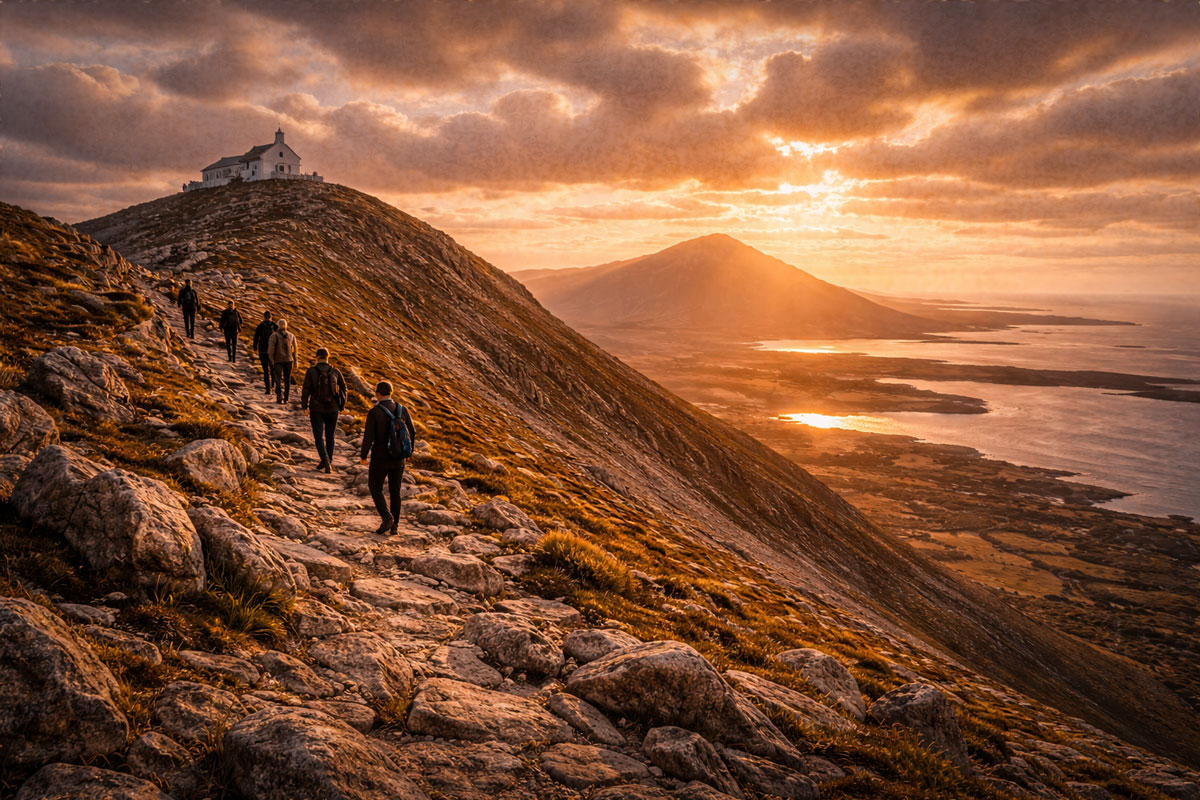
Croagh Patrick in County Mayo is perhaps the most famous sacred mountain in Ireland. Rising dramatically above Clew Bay, it has been a site of pilgrimage for over 1,500 years.
According to tradition, St. Patrick fasted on its summit for forty days in the 5th century. During this time, he is said to have banished serpents from Ireland and prayed for the protection of the Irish people.
Each year on Reek Sunday—the last Sunday in July—thousands of pilgrims climb Croagh Patrick. Some walk barefoot as an act of devotion. The ascent is steep and rocky, demanding both physical and mental resolve.
Archaeological evidence suggests that the mountain held spiritual significance even before Christianity, reinforcing its deep-rooted sacred identity.
At the summit stands a small chapel, simple and wind-beaten, reminding visitors that sacredness here comes not from ornamentation but from landscape and legacy.
Slieve League — Cliffs of Power and Solitude
In County Donegal, Slieve League rises dramatically above the Atlantic Ocean, boasting some of Europe’s highest sea cliffs. Though less associated with formal pilgrimage than Croagh Patrick, it carries profound spiritual resonance.
Early Christian hermitages once dotted these cliffs, where monks sought solitude and closeness to God. The vast Atlantic horizon reinforces a sense of awe and humility.
Prehistoric remains on the mountain suggest ritual activity long before monastic settlement. Stone structures and ancient pathways hint at earlier spiritual practices tied to sky and sea.
Standing atop Slieve League, visitors experience an almost elemental encounter with nature—wind, salt air, and endless ocean reinforcing the mountain’s sacred atmosphere.
Other Sacred Peaks Across Ireland
While Croagh Patrick and Slieve League are among the most famous, other mountains across Ireland hold spiritual significance.
Sliabh na mBan (County Tipperary)
Associated with ancient kingship rituals, this mountain is linked to early Irish sovereignty ceremonies.
Mount Brandon (County Kerry)
Named after St. Brendan the Navigator, Mount Brandon has long been a pilgrimage destination connected to early monastic routes.
The Paps of Anu (County Kerry)
These twin peaks are believed to be associated with the goddess Anu, reflecting pre-Christian sacred geography.
Across Ireland, place names preserve sacred meanings—often tied to saints, deities, or ancient gatherings.
Pilgrimage and Meaning Today
Modern pilgrimage to Ireland’s sacred mountains takes many forms. Some climb for religious devotion, others for personal reflection, cultural connection, or physical challenge.
Reek Sunday continues to draw thousands to Croagh Patrick, while Mount Brandon and other peaks attract walkers seeking quiet contemplation.
Even for secular visitors, these mountains evoke something deeper than scenery. The act of climbing—step by step—mirrors inner journeys of struggle and renewal.
Conservation efforts are increasingly important as visitor numbers grow. Protecting fragile mountain paths ensures that sacred landscapes remain accessible for future generations.
Conclusion
Ireland’s sacred mountains rise as natural monuments to faith, legend, and resilience. From Croagh Patrick’s pilgrimage path to the towering cliffs of Slieve League, these high places remind us that spirituality in Ireland has always been intertwined with landscape.
Whether approached through myth, history, or quiet reflection, Ireland’s mountains continue to inspire awe. They stand as enduring symbols of a culture that sees sacred meaning not only in built sanctuaries, but in wind-swept summits where earth meets sky.