



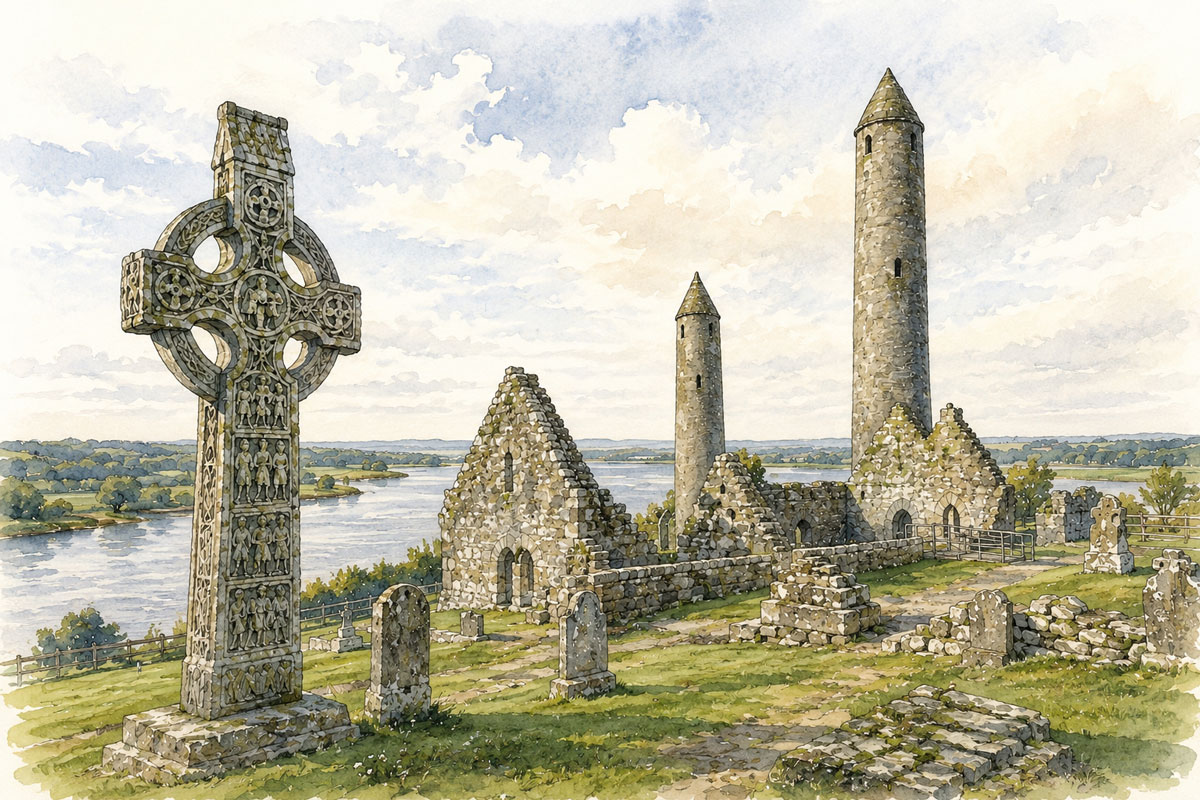

Nestled beside the banks of the mighty River Shannon in the heart of Ireland lies one of the country’s most remarkable historic treasures — Clonmacnoise. Once a thriving center of religion, learning, trade, and craftsmanship, this ancient monastic settlement played a defining role in shaping medieval Ireland.
Table of Contents
- The Founding of Clonmacnoise
- A City of Churches and Towers
- Viking Raids and Turbulent Times
- The River Shannon and Daily Life
- Ancient Graves and Royal Connections
- Visiting Clonmacnoise Today
- Why Clonmacnoise Still Matters
Far more than a simple monastery, Clonmacnoise was once considered one of the most important spiritual cities in Ireland. Founded in the 6th century, it became a destination for pilgrims, scholars, kings, and travelers from across Europe.
The Founding of Clonmacnoise
Clonmacnoise was founded around the year 544 AD by St. Ciarán, one of Ireland’s early saints. According to tradition, Ciarán chose the location carefully. The monastery stood where the River Shannon crossed the ancient east-west route known as the Slighe Mór, making it a strategic meeting point for travelers and merchants.
Although St. Ciarán died only a short time after establishing the monastery, his community quickly flourished. Over the centuries, Clonmacnoise developed into one of Ireland’s greatest centers of religion and scholarship. Monks copied manuscripts, taught students, crafted metalwork, and preserved learning during a period when much of Europe faced instability after the fall of the Roman Empire.
The monastery attracted people from all levels of society, including kings and nobles who wished to be buried there. Its influence spread far beyond Ireland, and by the medieval period Clonmacnoise had become internationally respected as a center of Christian learning.
A City of Churches and Towers
Unlike many smaller monastic settlements, Clonmacnoise grew into a large religious city filled with churches, workshops, homes, and burial grounds. Today, visitors can still explore the remains of numerous stone churches scattered across the site.
One of the most striking features of Clonmacnoise is its round towers. These tall stone towers served several purposes. They acted as bell towers, landmarks for travelers, and places of refuge during Viking raids. Rising high above the surrounding countryside, they remain symbols of Ireland’s early Christian age.
The site is also famous for its beautifully carved High Crosses. The Cross of the Scriptures, one of the finest surviving examples in Ireland, is decorated with intricate biblical scenes and Celtic designs.
Viking Raids and Turbulent Times
Because of its wealth and importance, Clonmacnoise became a frequent target during the Viking Age. Beginning in the 9th century, Viking raiders attacked the monastery multiple times, plundering treasures and burning buildings.
Yet Clonmacnoise repeatedly rebuilt itself. The resilience of the monks and local communities helped the settlement survive centuries of conflict. Later, the monastery also suffered during wars between Irish kingdoms and eventually during the Tudor conquest of Ireland.
Despite these hardships, the site remained active for many centuries. Pilgrims continued to visit, churches were repaired, and burials continued long after the medieval period ended.
The River Shannon and Daily Life
The location beside the River Shannon was central to Clonmacnoise’s success. The Shannon served as a vital transportation route connecting different regions of Ireland. Boats carried travelers, goods, and pilgrims directly to the monastery’s doorstep.
The monks of Clonmacnoise likely lived busy and disciplined lives. Their days revolved around prayer, study, farming, manuscript writing, and hospitality. Monasteries like Clonmacnoise often functioned as small self-sufficient communities.
Archaeological discoveries have revealed evidence of workshops where skilled craftsmen created metal objects, religious artifacts, and decorative items.
Ancient Graves and Royal Connections
Clonmacnoise became one of Ireland’s most prestigious burial places. Several High Kings of Ireland and important rulers are believed to have been buried there, including Ruaidrí Ua Conchobair, often remembered as the last High King of Ireland before the Norman invasion.
The site’s vast graveyard continued to attract burials for generations. Even today, many Irish families maintain connections to the cemetery, linking the present with centuries of history.
Walking through the graveyard reveals layers of Irish heritage stretching from the early Christian era to modern times.
Visiting Clonmacnoise Today
Modern visitors to Clonmacnoise can explore the monastery ruins, visitor center, churches, round towers, and ancient crosses while enjoying peaceful views of the River Shannon.
The visitor center houses original artifacts and displays that help explain the site’s history. One of the highlights is the original Cross of the Scriptures, whose detailed carvings remain remarkably impressive despite their great age.
Many travelers describe Clonmacnoise as one of the most atmospheric historic sites in Ireland due to its peaceful rural setting and rich spiritual history.
Why Clonmacnoise Still Matters
Clonmacnoise remains important not only because of its ancient ruins but because it represents a key chapter in Irish identity. The monastery symbolizes Ireland’s rich tradition of scholarship, spirituality, art, and resilience during difficult centuries of history.
At a time when much of medieval Europe experienced upheaval, Irish monasteries like Clonmacnoise helped preserve learning and culture. The manuscripts, craftsmanship, and teachings produced there contributed to Ireland’s reputation as a land of saints and scholars.
Today, the ruins continue to inspire historians, pilgrims, photographers, and travelers from around the world. Clonmacnoise remains one of Ireland’s most treasured links to its medieval past.