

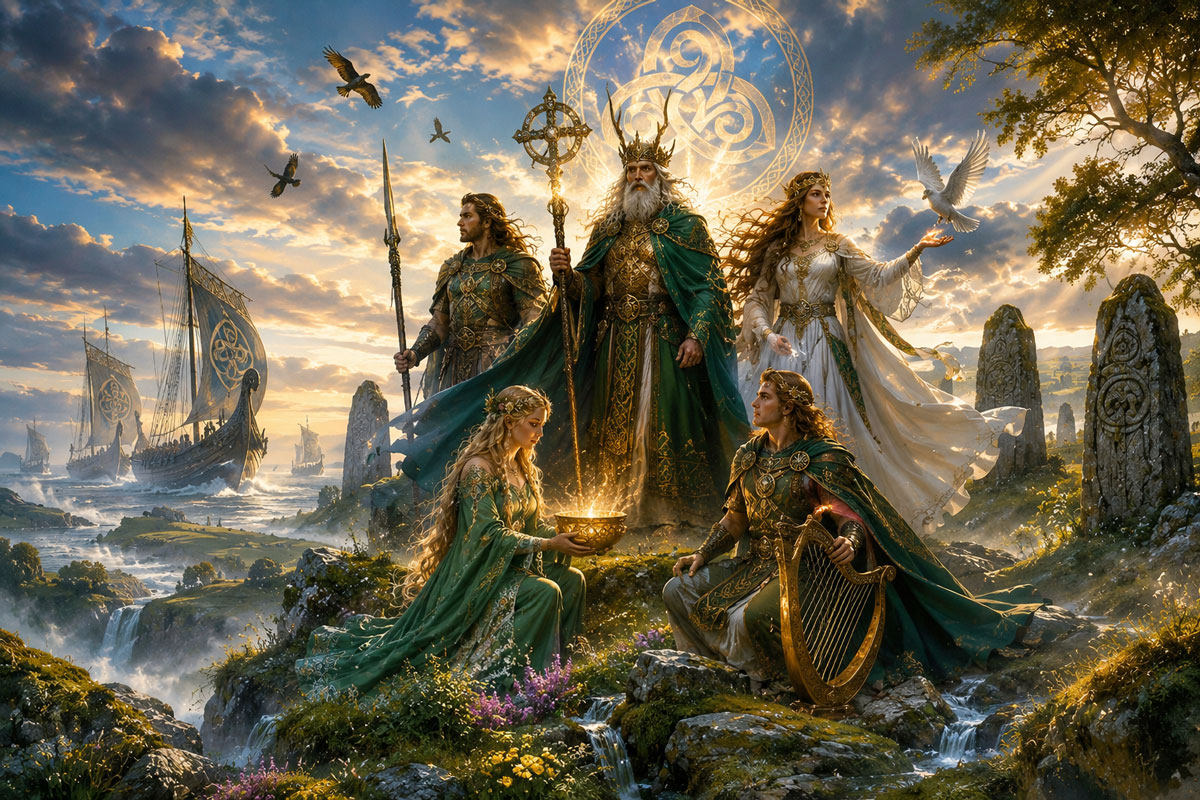

Among the many legends that make Irish mythology so fascinating, few are as enduring or mysterious as the stories of the Tuatha Dé Danann. Revered as a supernatural race possessing extraordinary powers, wisdom, and magical abilities, they occupy a central place in Ireland’s ancient folklore. Their tales have been passed down for centuries, blending myth, history, and imagination into stories that continue to captivate readers today.
Long before Ireland’s recorded history, the Tuatha Dé Danann were said to have ruled the island. They were described as beautiful, powerful, and highly skilled in the arts of magic, craftsmanship, healing, and warfare. Although often referred to as gods by modern scholars, the medieval Irish storytellers portrayed them as an extraordinary people whose abilities far surpassed those of ordinary humans.
Table of Contents
- Who Were the Tuatha Dé Danann?
- The Arrival in Ireland
- Masters of Magic and Knowledge
- The Four Treasures of the Tuatha Dé Danann
- Famous Members of the Tuatha Dé Danann
- The Battle Against the Fomorians
- Defeat by the Milesians
- The Tuatha Dé Danann and the Fairy Folk
- Their Legacy in Irish Culture
- Why the Tuatha Dé Danann Still Fascinate Us
Who Were the Tuatha Dé Danann?
The name “Tuatha Dé Danann” is usually translated as “The People of the Goddess Danu.” Danu is believed to have been an ancient mother goddess associated with fertility, abundance, and the natural world. According to Irish mythology, her descendants became one of the most powerful races ever to inhabit Ireland.
The primary sources for their stories come from medieval Irish manuscripts such as the Lebor Gabála Érenn (The Book of the Taking of Ireland) and the Mythological Cycle. These texts blend mythology and pseudo-history, presenting the Tuatha Dé Danann as one of several groups who settled Ireland in ancient times.
Unlike ordinary humans, they possessed supernatural abilities. They could influence the weather, heal wounds, shape-shift, cast powerful spells, and create magical objects. Their wisdom and knowledge were said to be unmatched, making them both respected and feared.
The Arrival in Ireland
One of the most dramatic episodes in Irish mythology describes the arrival of the Tuatha Dé Danann in Ireland. According to legend, they came from four mysterious northern cities where they had mastered magic, science, poetry, and warfare.
As they approached Ireland, they shrouded the land in a magical mist. Some versions of the story claim they burned their ships upon arrival so that retreat would be impossible. Their intention was clear—they had come to claim Ireland as their own.
At the time, Ireland was inhabited by another people known as the Fir Bolg. Conflict soon followed, leading to the First Battle of Mag Tuired. The Tuatha Dé Danann emerged victorious and became the new rulers of Ireland.
The story symbolizes the arrival of a powerful new culture, though historians generally regard it as mythology rather than actual history. Nevertheless, the tale remains one of the most famous origin stories in Irish folklore.
Masters of Magic and Knowledge
The Tuatha Dé Danann were renowned for their mastery of knowledge and magic. Unlike many mythological races who relied solely on physical strength, their greatest power often came from wisdom and skill.
They were said to excel in poetry, music, medicine, metalworking, and druidic arts. Their healers could cure severe wounds, while their craftsmen forged magical weapons and treasures. Their poets could inspire courage or cast powerful enchantments through verse.
This emphasis on learning reflects a theme found throughout Irish mythology: knowledge itself is a source of power. The Tuatha Dé Danann represent an idealized vision of a society where wisdom, creativity, and skill are valued alongside courage and strength.
Many of their stories involve cleverness overcoming brute force, demonstrating that intelligence and strategy often prove more effective than simple aggression.
The Four Treasures of the Tuatha Dé Danann
Among the most famous legends associated with the Tuatha Dé Danann are the Four Treasures they brought from their northern cities. These magical objects became symbols of kingship, authority, and divine power.
The Stone of Fál (Lia Fáil) was said to cry out whenever the rightful king of Ireland stood upon it.
The Spear of Lugh was an unbeatable weapon that never failed its wielder in battle.
The Sword of Nuada guaranteed victory once drawn, allowing no enemy to escape.
The Cauldron of the Dagda possessed endless abundance, ensuring that no one ever left it hungry.
Together, these treasures symbolized sovereignty, strength, wisdom, and prosperity. They remain among the most iconic objects in Irish mythology and continue to inspire modern writers and artists.
Famous Members of the Tuatha Dé Danann
Many legendary figures emerged from the Tuatha Dé Danann, each contributing unique stories to Irish mythology.
The Dagda was often regarded as their chief leader. Known as the “Good God,” he possessed immense strength, wisdom, and magical abilities. His great cauldron and enchanted harp became legendary symbols of his power.
Lugh was one of the most celebrated heroes of Irish mythology. Skilled in countless arts, he became known as Lugh of the Long Arm. His intelligence and leadership played a crucial role in defeating Ireland’s enemies.
Brigid was associated with poetry, healing, and craftsmanship. She later became linked with Saint Brigid, creating an interesting overlap between Ireland’s pagan and Christian traditions.
Nuada, the first king of the Tuatha Dé Danann, was known for his silver arm. After losing his hand in battle, skilled craftsmen fashioned a magical replacement, restoring his ability to rule.
These figures remain among the most beloved characters in Irish folklore and continue to appear in modern literature, films, and fantasy fiction.
The Battle Against the Fomorians
One of the most significant conflicts in Irish mythology was the struggle between the Tuatha Dé Danann and the Fomorians. The Fomorians were often portrayed as chaotic and destructive beings associated with storms, darkness, and the untamed forces of nature.
The conflict reached its climax during the Second Battle of Mag Tuired. Under the leadership of Lugh, the Tuatha Dé Danann united against the Fomorian king Balor, whose deadly eye could destroy entire armies.
According to legend, Lugh defeated Balor by striking his destructive eye with a sling stone. This victory symbolized the triumph of order, skill, and civilization over chaos and destruction.
The battle remains one of the greatest heroic tales in Irish mythology and is often compared to epic conflicts found in Greek and Norse legends.
Defeat by the Milesians
Although the Tuatha Dé Danann defeated many enemies, their rule did not last forever. Eventually, a new group known as the Milesians arrived in Ireland. According to legend, the Milesians were the ancestors of the modern Irish people.
After a series of encounters and magical contests, the Tuatha Dé Danann were ultimately defeated. However, they were not destroyed. Instead, a peace agreement divided Ireland between the two peoples.
The Milesians would rule the surface world, while the Tuatha Dé Danann would dwell beneath the hills and mounds scattered across the landscape.
This transition marked a major turning point in Irish mythology and laid the foundation for many later fairy legends.
The Tuatha Dé Danann and the Fairy Folk
Following their withdrawal from the surface world, the Tuatha Dé Danann became associated with the Aos Sí, often translated as the fairy folk or people of the mounds.
Ancient burial mounds, ring forts, and mysterious earthworks across Ireland were believed to serve as entrances to their hidden realm. Many traditional Irish stories warned against disturbing these places, as doing so might anger their supernatural inhabitants.
Over time, the powerful gods of mythology gradually evolved into the fairy beings of folklore. Yet traces of their former greatness remained, with many stories describing them as beautiful, immortal, and capable of extraordinary magic.
This blending of mythology and folklore helped preserve their legends long after Ireland became a Christian nation.
Their Legacy in Irish Culture
The influence of the Tuatha Dé Danann can still be found throughout Ireland today. Their stories appear in literature, music, artwork, and modern fantasy fiction. Countless hills, rivers, and archaeological sites are connected to their legends.
Many aspects of Irish folklore, including fairy beliefs, sacred landscapes, and seasonal traditions, can trace their roots back to stories involving the Tuatha Dé Danann.
They also continue to inspire modern interpretations of Celtic spirituality and mythology. Writers and historians frequently revisit their tales, exploring what these legends reveal about Ireland’s ancient worldview.
For many people, the Tuatha Dé Danann represent a bridge between Ireland’s mythological past and its cultural identity today.
Why the Tuatha Dé Danann Still Fascinate Us
More than a thousand years after their stories were first written down, the Tuatha Dé Danann continue to capture the imagination. Their tales combine heroism, magic, mystery, and adventure in ways that remain compelling to modern audiences.
They are not merely characters from old legends. They symbolize Ireland’s deep connection to storytelling, landscape, and imagination. Whether viewed as gods, heroes, ancestors, or fairy beings, they occupy a unique place in Irish culture.
The hills, rivers, and ancient monuments of Ireland still echo with stories of the Tuatha Dé Danann. Their legends remind us that mythology is more than entertainment—it is a way of understanding how people once viewed the world and their place within it.
As long as Irish myths continue to be told, the Tuatha Dé Danann will remain among the most fascinating figures in Ireland’s rich and enduring heritage.
“`