

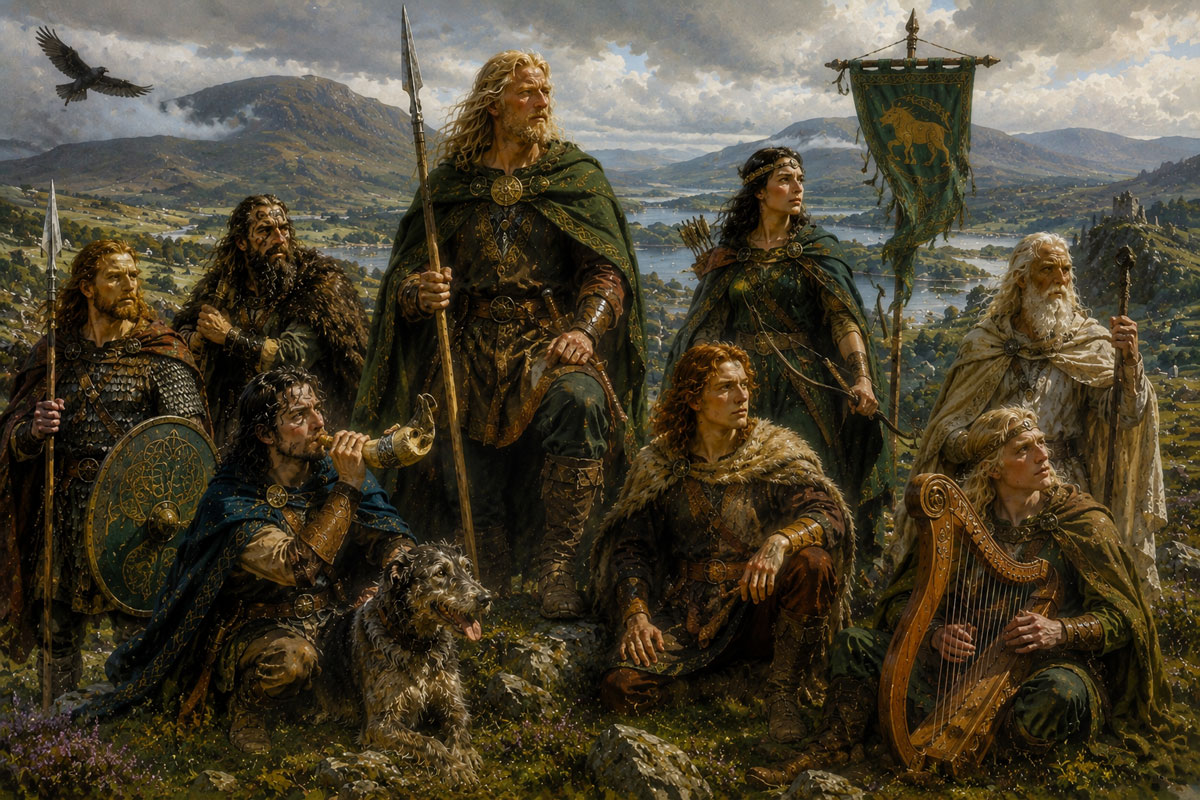

Among the great bodies of Irish mythology, the Fenian Cycle stands as one of the most beloved and enduring. Filled with heroic warriors, magical adventures, epic battles, and timeless romances, these stories have been told around Irish hearths for centuries. At the heart of the Fenian Cycle is Fionn mac Cumhaill, the legendary leader of the Fianna, a band of elite warriors who protected Ireland while living between the civilized world and the wild landscapes of the island.
The tales of Fionn and his companions blend history, folklore, and mythology into a rich collection of stories that continue to inspire books, films, music, and modern interpretations of Irish heritage. Their adventures reveal not only bravery and strength but also wisdom, loyalty, and the deep connection between the Irish people and their land.
Table of Contents
- What Is the Fenian Cycle?
- Who Was Fionn mac Cumhaill?
- The Origins of Fionn
- The Salmon of Knowledge
- The Fianna: Ireland’s Legendary Warriors
- Adventures and Heroic Deeds
- Fionn and the Giant’s Causeway
- Oisín and Tír na nÓg
- The Legacy of the Fenian Cycle
- Why These Legends Endure
What Is the Fenian Cycle?
The Fenian Cycle is one of the four major cycles of Irish mythology. While the Mythological Cycle focuses on the Tuatha Dé Danann and the Ulster Cycle centers on heroes such as Cú Chulainn, the Fenian Cycle tells the stories of Fionn mac Cumhaill and the Fianna.
Most of these tales are set during a semi-legendary period of ancient Ireland. They were passed down orally for generations before eventually being recorded in medieval manuscripts by Irish monks and scribes.
The stories emphasize courage, loyalty, friendship, wisdom, and adventure. They often take place in forests, mountains, rivers, and remote parts of Ireland, reflecting the close relationship between the Fianna and the natural world.
Who Was Fionn mac Cumhaill?
Fionn mac Cumhaill, often anglicized as Finn McCool, is one of the greatest heroes in Irish folklore. He was renowned not only for his strength and skill in battle but also for his intelligence and wisdom.
As leader of the Fianna, Fionn commanded a group of highly trained warriors who served the High King of Ireland. Unlike ordinary soldiers, members of the Fianna lived according to strict codes of honor and were expected to excel in hunting, poetry, combat, and survival.
Fionn appears in hundreds of stories throughout Irish folklore. In some tales he is a mighty warrior. In others he acts as a wise judge, poet, or protector of the people. This combination of strength and wisdom helped make him one of Ireland’s most admired legendary figures.
The Origins of Fionn
The early life of Fionn is filled with danger and prophecy. His father, Cumhall, was leader of the Fianna but was killed in battle before Fionn was born. Fearing for the child’s safety, his mother entrusted him to two warrior women who raised him in secret.
Growing up in the wilderness, Fionn learned hunting, tracking, combat, and survival skills. He became strong, intelligent, and highly observant. These experiences prepared him for the challenges that lay ahead.
Eventually, Fionn returned to claim his rightful place among the Fianna. Through courage and wisdom, he earned the respect of the warriors and ultimately became their leader.
His rise from hidden child to legendary hero remains one of the most inspiring journeys in Irish mythology.
The Salmon of Knowledge
One of the most famous stories associated with Fionn is the tale of the Salmon of Knowledge.
According to legend, a wise poet named Finegas spent years trying to catch a magical salmon that possessed all the knowledge of the world. When he finally succeeded, he instructed young Fionn to cook the fish but not eat any of it.
While cooking the salmon, Fionn accidentally burned his thumb and instinctively placed it in his mouth. In that moment, the wisdom of the salmon passed into him.
From then on, whenever Fionn placed his thumb against his tooth, he could access extraordinary knowledge and insight.
This story remains one of the best-known myths in Ireland and symbolizes the value placed on wisdom and learning in Irish tradition.
The Fianna: Ireland’s Legendary Warriors
The Fianna were far more than a military force. They were an elite brotherhood of warriors, hunters, poets, and adventurers who roamed Ireland protecting the land.
Joining the Fianna required passing demanding physical and mental tests. Candidates had to demonstrate courage, athletic ability, and mastery of poetry. They were expected to defend the weak, honor their word, and uphold justice.
Members lived close to nature, spending much of their time hunting and traveling through Ireland’s forests and mountains. Their stories often feature encounters with magical creatures, rival warriors, and supernatural beings.
Among the most famous members were Oisín, Fionn’s gifted son and poet; Caoilte, known for his incredible speed; and Diarmuid Ua Duibhne, celebrated for his bravery and tragic love story.
Adventures and Heroic Deeds
The Fenian Cycle contains countless adventures that showcase the courage and skill of Fionn and his companions.
Some tales involve battles against rival warriors and invading forces. Others tell of encounters with magical beasts, enchanted castles, and mysterious figures from the Otherworld.
One recurring theme is the defense of Ireland against threats both human and supernatural. Whether facing giants, monsters, or enemy armies, the Fianna consistently act as protectors of the land.
The stories often balance action with humor, wisdom, and moral lessons. Unlike some heroic legends that focus solely on warfare, the Fenian Cycle highlights friendship, loyalty, and personal honor.
These qualities helped make the stories popular across generations and ensured their survival through centuries of storytelling.
Fionn and the Giant’s Causeway
Perhaps the most famous legend involving Fionn concerns the Giant’s Causeway in County Antrim.
According to folklore, Fionn built a stone causeway across the sea to challenge a Scottish giant named Benandonner. However, when he saw the enormous size of his opponent, he became concerned.
Fionn’s clever wife, Sadhbh, disguised him as a baby and placed him in a cradle. When Benandonner arrived and saw the gigantic “child,” he imagined how enormous the father must be and fled back to Scotland in terror.
As he escaped, he destroyed much of the causeway behind him, leaving only the remarkable stone formations visible today.
While geologists explain the Giant’s Causeway as the result of volcanic activity, the legend remains one of Ireland’s most entertaining folktales.
Oisín and Tír na nÓg
One of the most beautiful stories connected to the Fenian Cycle is the tale of Oisín and Tír na nÓg, the Land of Eternal Youth.
Oisín fell in love with Niamh, a princess from the Otherworld. She invited him to accompany her to Tír na nÓg, a magical realm where there was no aging, sickness, or death.
Although Oisín believed he spent only a few years there, centuries passed in Ireland. Eventually, he longed to see his homeland again. Niamh allowed him to return but warned him never to touch the ground.
While helping some men move a stone, Oisín fell from his horse. The moment he touched Irish soil, the years caught up with him, and he became an old man.
The story is one of Ireland’s most poignant legends and explores themes of love, loss, time, and the passage of generations.
The Legacy of the Fenian Cycle
The influence of the Fenian Cycle can still be felt throughout Ireland today. Place names, landmarks, and local traditions across the country are connected to stories of Fionn and the Fianna.
Many ancient sites are associated with their adventures, particularly in counties such as Antrim, Sligo, Kerry, and Dublin. Folklore surrounding these places continues to be passed down through local storytelling traditions.
The stories also inspired poets, writers, and artists during the Irish Literary Revival. Figures such as William Butler Yeats drew heavily upon Fenian legends when exploring Ireland’s cultural identity.
Even today, Fionn remains one of the most recognizable heroes in Irish mythology and folklore.
Why These Legends Endure
The enduring popularity of the Fenian Cycle comes from its combination of adventure, wisdom, humor, and humanity. Fionn and the Fianna are heroic, but they are also relatable. They face difficult choices, experience triumph and tragedy, and navigate a world filled with both wonder and danger.
The stories celebrate qualities that remain timeless: courage, loyalty, friendship, wisdom, and respect for nature. They connect readers to Ireland’s landscapes and cultural heritage while offering exciting tales that continue to entertain.
More than a thousand years after these stories were first told, Fionn mac Cumhaill and the Fianna remain among the greatest heroes of Irish folklore. Their adventures continue to inspire new generations and ensure that the spirit of the Fenian Cycle lives on.
“`