




For generations, religion influenced almost every part of life in Ireland. Few periods demonstrate this more clearly than the era of the Penal Laws, a collection of restrictions introduced mainly during the late seventeenth and eighteenth centuries. These laws affected political power, land ownership, education, religious practice, inheritance, and access to public life, leaving a lasting mark on Irish society. The Penal Laws were directed primarily against Roman Catholics, who made up the majority of Ireland’s population, although Protestant Dissenters such as Presbyterians were also subjected to important restrictions.
Rather than being one single law introduced at one moment, the Penal Laws developed through a series of measures designed to protect the political and religious dominance of the Protestant establishment. Their influence reached far beyond churches and religious practice. They helped determine who could own land, hold political office, receive certain forms of education, and exercise power. Understanding the Penal Laws therefore provides an important window into the religious divisions, inequalities, and political struggles that shaped modern Ireland.
Table of Contents
- Why Were the Penal Laws Introduced?
- What Did the Penal Laws Restrict?
- Land Ownership and Inheritance
- Education and the Hedge Schools
- Catholic Worship and the Priesthood
- Protestant Dissenters and the Penal Laws
- How the Laws Changed Irish Society
- The Gradual Relaxation of the Penal Laws
- Catholic Emancipation
- The Lasting Legacy of the Penal Era
Why Were the Penal Laws Introduced?
The origins of the Penal Laws can only be understood within the religious and political conflicts that transformed Ireland, England, Scotland, and much of Europe during the seventeenth century. Following the Protestant Reformation, religion became closely connected with political loyalty. England’s rulers feared Catholic powers abroad and worried that Irish Catholics might support Catholic monarchs or foreign intervention against the Protestant state.
These fears intensified during the wars of the seventeenth century. The defeat of the Catholic King James II by the Protestant William III, particularly following the Williamite War in Ireland, strengthened Protestant political control. In the decades that followed, the Irish Parliament introduced a series of laws intended to secure that control. Catholics were viewed not simply as members of a different religion but as a potential political threat to the established order. The result was a legal system that placed significant restrictions on the Catholic majority while consolidating power in the hands of the Protestant establishment.
What Did the Penal Laws Restrict?
The Penal Laws affected many areas of life. Catholics faced restrictions concerning political participation, public office, land, education, weapons, and the practice and organization of their religion. The exact restrictions changed over time, and enforcement varied considerably from place to place. Some measures were rigorously applied, while others were ignored or circumvented depending upon local circumstances.
Nevertheless, their combined effect was significant. Catholics were largely excluded from the institutions through which political and economic power was exercised. The laws helped create a society in which religious affiliation could strongly influence a person’s opportunities, property rights, education, and political standing.
Land Ownership and Inheritance
Land was one of the most important sources of wealth and political influence in early modern Ireland, making restrictions on Catholic landholding particularly significant. By the beginning of the eighteenth century, much of the land that had once belonged to Catholic families had already changed hands through plantations, confiscations, and the consequences of seventeenth-century wars. The Penal Laws placed further pressure on Catholic landholders, restricting their ability to acquire property and imposing inheritance provisions that could contribute to the fragmentation of Catholic estates.
These measures helped strengthen the position of the Protestant landowning class and contributed to a society in which many Catholic families lived as tenants rather than substantial landowners. The relationship between landlord and tenant would remain one of the most important and contentious issues in Irish history long after the Penal era itself had ended.
Education and the Hedge Schools
Education was another area affected by religious restrictions. Catholics faced serious limitations on access to formal education conducted according to their faith, and Catholic teachers operated under significant legal constraints. One response was the development of what became known as hedge schools. Despite the name, lessons did not necessarily take place literally beside hedges. Classes could be held in cottages, barns, small buildings, or wherever suitable space could be found.
Teachers provided instruction in subjects that could include reading, writing, arithmetic, Latin, Greek, and sometimes Irish. The schools varied greatly in quality and organization, but they became an important part of popular education. The hedge school has since become a powerful symbol of the determination of ordinary Irish people to pursue learning despite social and religious restrictions, and Ireland’s strong cultural respect for education survived long beyond the Penal era.
Catholic Worship and the Priesthood
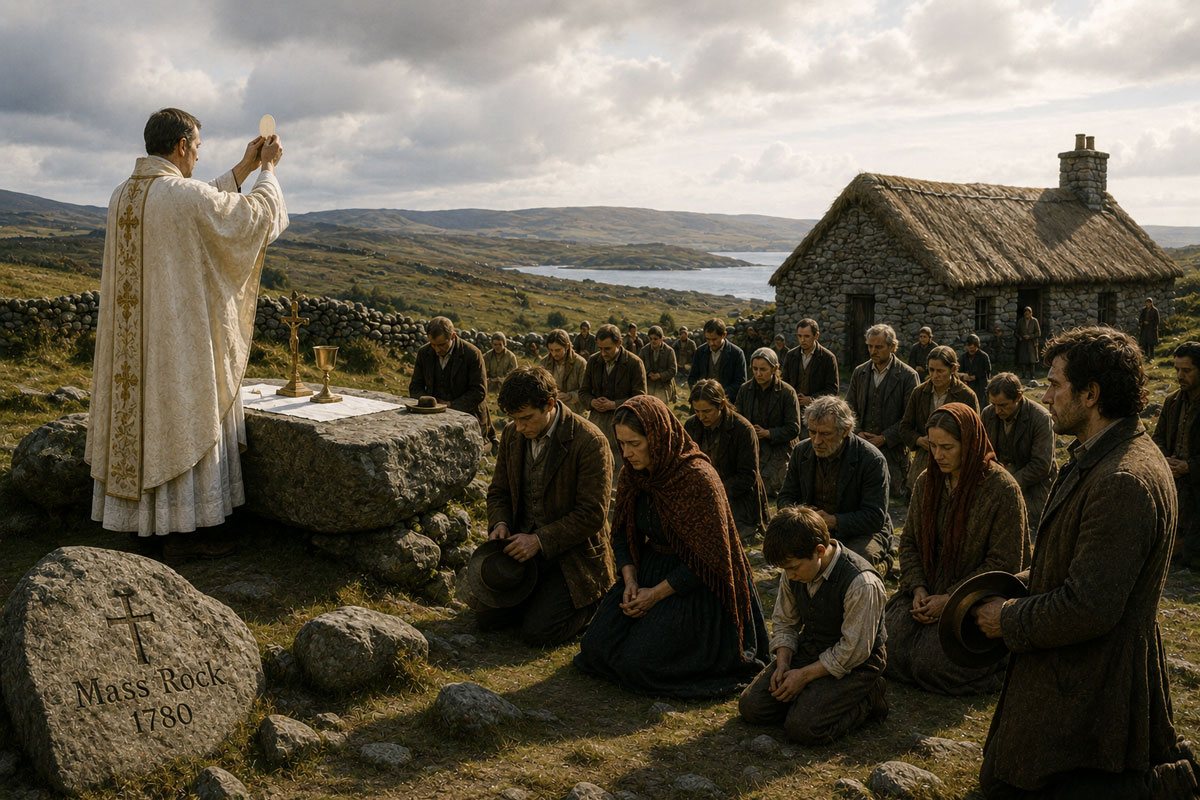
The Penal era also placed significant pressure on the Catholic Church. Laws restricted the activities of Catholic clergy, particularly bishops and members of religious orders, and attempted to limit the institutional strength of Catholicism. Yet Catholic religious practice continued. Priests ministered to communities under difficult circumstances, while worship could take place in private homes, modest chapels, or secluded outdoor locations.
Across Ireland, places known as Mass rocks became associated with worship during periods when Catholics faced restrictions or insecurity. These natural or roughly fashioned stone altars were often located in isolated countryside. Not every surviving Mass rock can be definitively connected with the strictest periods of persecution, but they have become powerful symbols of the persistence of Catholic worship in Ireland and of communities determined to maintain their religious traditions.
Protestant Dissenters and the Penal Laws
Although Catholics experienced the most extensive restrictions, they were not the only religious community disadvantaged by the political system. Protestant Dissenters, particularly Presbyterians in Ulster, also faced restrictions because they did not belong to the established Church of Ireland. Measures such as the sacramental test prevented many Dissenters from holding certain public offices unless they conformed to the established church.
This distinction is important because eighteenth-century Ireland was not divided simply between Catholics and Protestants. Significant divisions existed within Protestant society as well. Grievances among Presbyterians and other reform-minded Protestants later contributed to political movements demanding greater representation and equality, most famously the Society of United Irishmen during the 1790s.
How the Laws Changed Irish Society
The Penal Laws reinforced a social structure in which political and economic power was concentrated among members of the established Protestant elite, later commonly described as the Protestant Ascendancy. Its members dominated Parliament, major landholdings, government positions, and many of Ireland’s most influential institutions. For the Catholic majority, exclusion from political power and restrictions on property contributed to a profound sense of inequality. Religion became closely intertwined with questions of class, land, political representation, and eventually national identity.
These divisions did not disappear when individual Penal Laws were repealed. They influenced relationships between communities for generations and became part of the wider debate over who held power in Ireland. At the same time, ordinary people found ways to adapt. Informal education, private and local worship, family networks, and community traditions helped preserve religious and cultural identities despite the restrictions imposed upon them.
The Gradual Relaxation of the Penal Laws
By the later eighteenth century, attitudes toward the Penal Laws were beginning to change. Political circumstances had shifted, and some members of the Protestant establishment increasingly regarded the restrictions as unnecessary or counterproductive. A series of Catholic Relief Acts gradually removed many of the barriers, allowing Catholics improved rights relating to property and education while reducing some restrictions on political and professional participation.
The process was gradual rather than immediate, and religious inequality remained an important political issue. Catholics still lacked full political rights, but the relief measures represented a major change in direction. The system that had been constructed to preserve Protestant political dominance was slowly being dismantled as ideas about religious tolerance and political participation evolved.
Catholic Emancipation
The campaign for full Catholic political rights became one of the defining political movements of early nineteenth-century Ireland. Its most famous leader was Daniel O’Connell, a lawyer and politician who mobilized enormous popular support for Catholic Emancipation through peaceful political organization. His Catholic Association developed into a powerful mass movement, demonstrating that ordinary Catholics could become an influential political force.
In 1828, O’Connell won election as an MP for County Clare despite being unable to take his seat under the existing rules because he was Catholic. The political pressure created by his victory helped force the British government to act. The Roman Catholic Relief Act of 1829 allowed Catholics to sit in Parliament and removed many of the remaining political restrictions. Although discrimination and inequality did not disappear, Catholic Emancipation represented a major turning point in Irish history.
The Lasting Legacy of the Penal Era
The importance of the Penal Laws extends far beyond the eighteenth century. They contributed to patterns of land ownership, political exclusion, religious division, and social inequality whose consequences continued to influence Ireland for generations. They also produced powerful cultural memories. Stories of hedge schools, Mass rocks, hidden priests, and families preserving their faith became part of the historical identity of Irish Catholic communities.
Modern historians have added important nuance to some traditional accounts, emphasizing that enforcement varied and that everyday life during the Penal era was often more complicated than later popular memory suggested. Nevertheless, the legal inequalities themselves were real and had profound consequences. Religious identity could influence access to land, education, government, and public life, shaping opportunities from one generation to the next.
Understanding the Penal Laws helps explain many of the political, religious, and social tensions that emerged in later Irish history. The laws were eventually dismantled, but the society they helped create left a legacy that endured long after the restrictions themselves had disappeared. They remain an important reminder of a period when religion was not simply a matter of personal faith, but a powerful force capable of determining a person’s place within Irish society.