



Long before modern courts and legal systems, Ireland developed a sophisticated and uniquely humane code of law known as Brehon Law. Rooted in tradition, custom, and community responsibility, this ancient system governed Irish society for over a thousand years. Far from primitive, Brehon Law reflected a deep understanding of justice, balance, and social order—offering insights into how early Ireland functioned long before outside influence reshaped the island.
Table of Contents
- Origins of Brehon Law
- Who Were the Brehons?
- Key Principles of the Legal System
- How Brehon Law Shaped Irish Society
- Decline and Legacy of Brehon Law
Origins of Brehon Law
Brehon Law, known in Irish as Fénechas, was the native legal system of Ireland, developing over centuries before the arrival of the Normans in the 12th century. Its origins lie in early Gaelic society, where law was passed down orally before being recorded in manuscripts during the early medieval period.
Unlike Roman or later English legal systems, Brehon Law was not imposed by a central authority. Instead, it evolved organically from customs, traditions, and agreements within communities. It reflected the values of a society that prioritized kinship, honor, and social balance.
Early law texts were eventually written by monastic scholars, preserving rules that governed everything from land ownership and marriage to contracts and compensation.
This system remained in use for over a millennium, making it one of the longest-lasting legal traditions in Europe.
Who Were the Brehons?
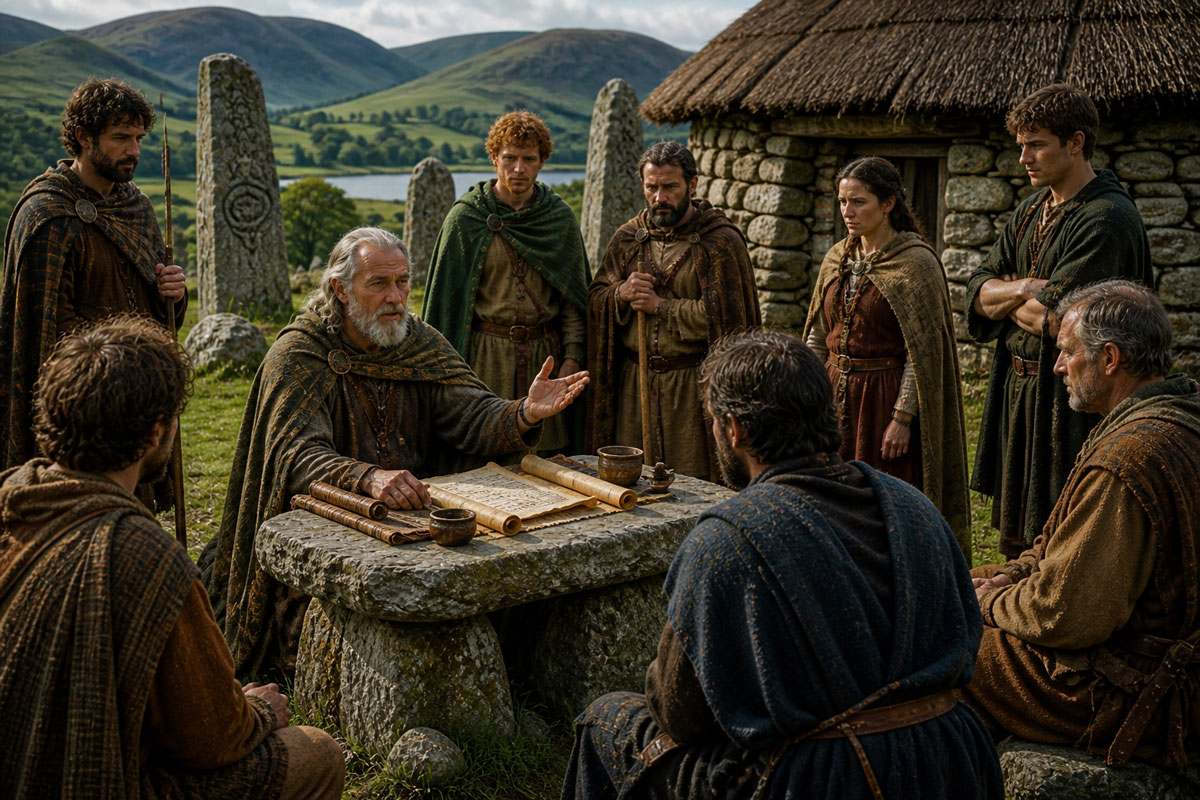
The term “Brehon” comes from the Irish word breitheamh, meaning judge. Brehons were highly trained legal experts who interpreted and applied the law within Gaelic society.
Unlike modern judges, Brehons did not create laws or enforce punishments directly. Instead, they acted as arbiters, offering legal judgments based on established customs and precedents.
Training to become a Brehon required years of study. Legal knowledge was often passed down through families, creating hereditary lines of legal scholars.
Brehons were respected figures in society, valued for their wisdom, memory, and understanding of complex legal principles. Their role depended heavily on reputation—fair and balanced decisions ensured trust within the community.
Rather than operating in courts as we know them today, Brehons worked within a system that relied on cooperation and mutual agreement.
Key Principles of the Legal System
Brehon Law was built on principles that differed significantly from later European systems.
Restorative Justice
Instead of punishment through imprisonment or execution, Brehon Law focused on compensation. If a wrong was committed, the offender was required to compensate the injured party or their family. This approach aimed to restore balance rather than impose retribution.
Honor and Status
An individual’s social standing, known as honor price, influenced legal outcomes. Compensation amounts varied depending on a person’s rank, reflecting a structured but flexible social hierarchy.
Collective Responsibility
Family and kin groups often shared responsibility for an individual’s actions. This reinforced strong social bonds and encouraged communities to maintain order internally.
Contracts and Agreements
Brehon Law placed great importance on agreements. Contracts governed trade, land use, and relationships, demonstrating a highly organized economic system.
Rights of Women
Remarkably for its time, Brehon Law granted women certain legal rights, including property ownership and the ability to initiate divorce under specific conditions.
These principles reveal a legal system deeply rooted in fairness, negotiation, and social stability.
How Brehon Law Shaped Irish Society
Brehon Law was closely tied to the structure of Gaelic society. Ireland was divided into territories ruled by local kings, but power was decentralized and often negotiated rather than imposed.
Land was typically held collectively by extended families rather than owned outright by individuals. Laws governed how land was shared, inherited, and used, ensuring stability within communities.
The system also regulated fosterage, a common practice in which children were raised by other families to strengthen alliances and social ties.
Trade and craftsmanship were protected through legal agreements, while poets, scholars, and craftsmen held recognized roles within society.
Because enforcement relied on cooperation, reputation and honor were essential. A person who ignored legal obligations risked social exclusion—a powerful consequence in a tightly connected society.
Decline and Legacy of Brehon Law
The arrival of the Normans in the 12th century marked the beginning of the decline of Brehon Law. Over time, English common law gradually replaced native systems, particularly in areas under stronger colonial control.
However, Brehon Law continued to operate in Gaelic regions for several centuries, especially in the west and north of Ireland.
By the 17th century, it had largely been suppressed, though elements of its influence lingered in local customs and traditions.
Today, Brehon Law is studied as a remarkable example of early legal thought. Its emphasis on restorative justice, community responsibility, and negotiated solutions has attracted renewed interest in modern times.
Far from being a primitive system, it reveals a sophisticated society that valued balance, fairness, and the maintenance of social harmony.
Conclusion
Brehon Law offers a window into a uniquely Irish way of understanding justice. Developed over centuries and rooted in tradition, it governed a society built on relationships, honor, and mutual responsibility.
Though eventually replaced, its legacy remains an important part of Ireland’s heritage. By examining Brehon Law, we gain insight not only into how early Irish society functioned, but also into alternative ways of thinking about justice—ones that continue to resonate today.