



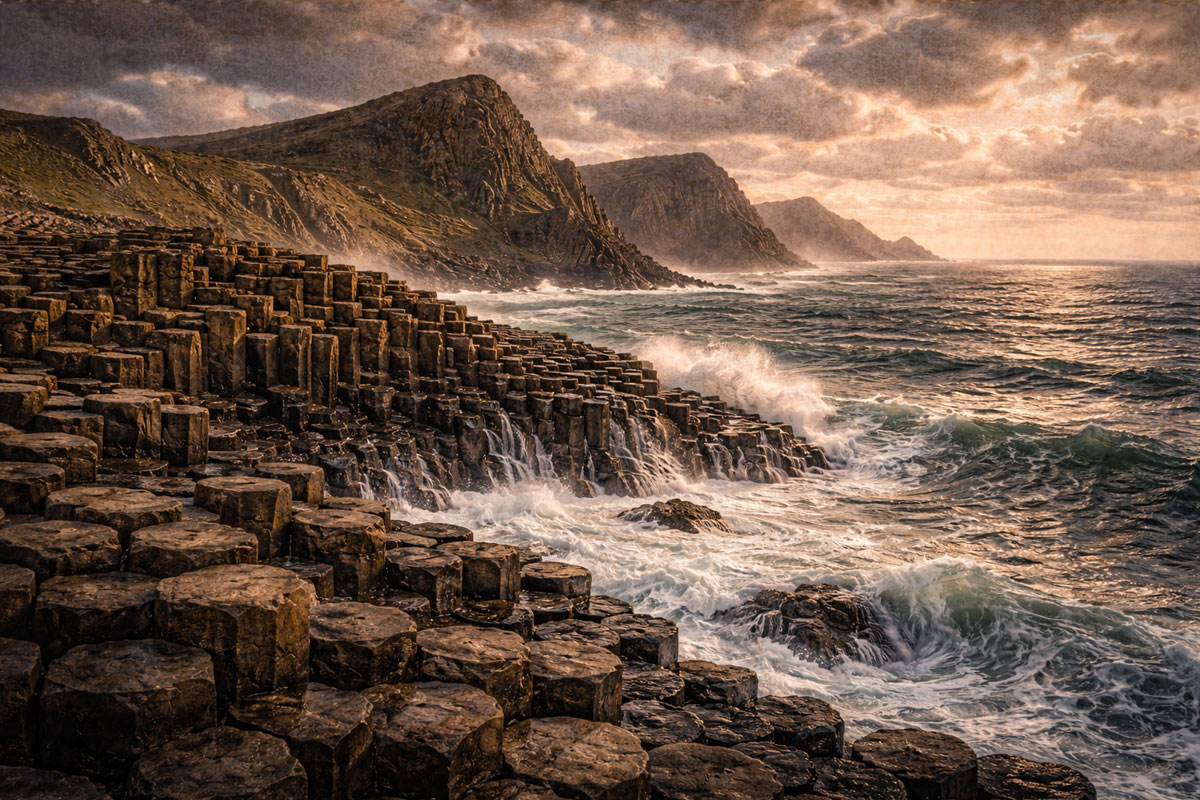

Along Northern Ireland’s rugged shoreline lies one of the most extraordinary landscapes in Europe. The Causeway Coast is a place where geology meets mythology, where towering cliffs face the Atlantic, and where ancient legends cling as firmly as the hexagonal stones beneath your feet. At its heart stands the Giant’s Causeway—an awe-inspiring natural formation shaped by volcanic forces and centuries of storytelling.
Table of Contents
- The Geological Origins of the Giant’s Causeway
- Finn McCool and the Legend of the Causeway
- Cliffs, Castles, and Coastal Drama
- The Causeway Coast as Living Heritage
- Experiencing the Causeway Coast Today
The Geological Origins of the Giant’s Causeway
The Giant’s Causeway is one of Ireland’s most remarkable natural phenomena. Composed of around 40,000 interlocking basalt columns, it was formed approximately 60 million years ago during intense volcanic activity.
As molten lava cooled rapidly upon contact with air and sea, it contracted and cracked into the distinctive hexagonal shapes seen today. The result is a geometric landscape so precise that it appears almost man-made.
Recognized as a UNESCO World Heritage Site, the Causeway stands as a testament to the island’s ancient geological forces. The basalt columns extend from the shoreline into the sea, forming stepping-stone patterns that have captivated visitors for centuries.
Though science explains its formation, the landscape’s symmetry and scale have long invited myth and imagination.
Finn McCool and the Legend of the Causeway
According to Irish legend, the Giant’s Causeway was built not by volcanic forces but by the giant Finn McCool (Fionn mac Cumhaill). As the story goes, Finn constructed the stone causeway across the sea to confront his Scottish rival, Benandonner.
When Finn realized his opponent was far larger than expected, he retreated in fear. With the help of his clever wife, Oonagh, he disguised himself as a baby. When Benandonner saw the enormous “child,” he imagined the father must be truly colossal and fled back to Scotland, tearing up the causeway behind him.
This tale remains one of Ireland’s most beloved myths, blending humor, bravery, and quick thinking. It also reflects a long-standing cultural habit: interpreting natural wonders through storytelling.
Even today, formations at the site bear imaginative names such as the Giant’s Boot, the Wishing Chair, and the Organ Pipes—linking geology to folklore.
Cliffs, Castles, and Coastal Drama
The Causeway Coast extends far beyond the basalt columns themselves. Dramatic cliffs rise from the Atlantic, carved by wind and waves over millennia.
Dunluce Castle, perched precariously on a rocky headland, adds medieval drama to the scenery. Once a stronghold of the MacDonnell clan, its ruins evoke tales of clan rivalries and maritime power.
The Carrick-a-Rede rope bridge offers another striking feature. Originally used by fishermen to reach salmon nets, it now provides visitors with breathtaking views of cliffs and sea.
Further inland, rolling green hills and quiet glens soften the landscape, creating a contrast between wild coast and sheltered valley.
This interplay of stone, sea, and sky defines the region’s identity.
The Causeway Coast as Living Heritage
The Causeway Coast is not merely a geological site—it is part of a broader cultural landscape. Generations of fishing families, farmers, and storytellers have shaped life along this shore.
Place names, local traditions, and oral history preserve connections between people and landscape. Music, language, and folklore continue to thrive in nearby communities.
The area also reflects Ireland’s complex political history. Positioned in Northern Ireland, the Causeway Coast stands within a region shaped by plantation, conflict, and reconciliation. Today, it welcomes visitors from around the world, symbolizing both natural wonder and shared heritage.
Environmental conservation plays a key role in protecting fragile cliff habitats and marine ecosystems, ensuring that future generations can experience this dramatic coastline.
Experiencing the Causeway Coast Today
Walking among the basalt columns offers a rare sense of connection to deep time. The patterns beneath your feet remind you that this landscape was formed long before human settlement.
Coastal trails provide panoramic views of crashing waves and distant headlands. At sunset, the stones glow with golden light, heightening their otherworldly appearance.
Whether approached through science or legend, the Causeway Coast invites reflection. It is a place where myth and geology coexist—where imagination enhances understanding rather than replacing it.
Conclusion
The Causeway Coast stands as one of Ireland’s most compelling landscapes—a meeting point of volcanic power, medieval history, and enduring legend. From the hexagonal columns of the Giant’s Causeway to the ruins of Dunluce Castle, the region captures the imagination while grounding visitors in geological reality.
Here, cliffs and basalt formations tell a story written in stone, while folklore ensures that the narrative remains alive. The Causeway Coast is more than a scenic destination—it is a testament to Ireland’s ability to blend natural wonder with cultural memory.