



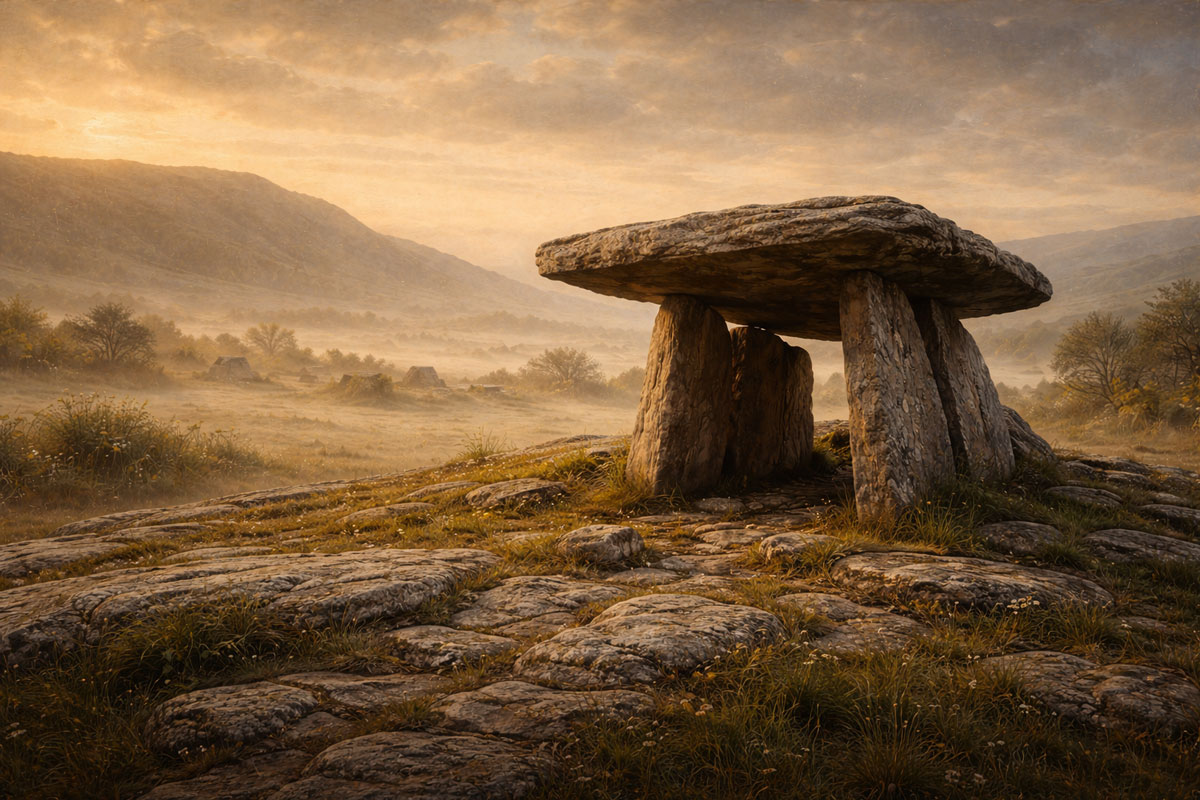

Scattered across Ireland’s fields, hillsides, and coastal plains lie some of the oldest stone monuments in Europe. Built thousands of years before the pyramids of Egypt, Ireland’s megalithic tombs offer a profound connection to the island’s earliest inhabitants. From the stark beauty of Poulnabrone Dolmen to the vast cemetery at Carrowmore, these ancient sites reveal a landscape shaped by ritual, belief, and remembrance.
Table of Contents
- The Origins of Ireland’s Megalithic Tombs
- Types of Megalithic Tombs in Ireland
- Poulnabrone Dolmen: An Icon of the Burren
- Carrowmore and Ireland’s Ancient Sacred Landscapes
The Origins of Ireland’s Megalithic Tombs
Ireland’s megalithic tombs date primarily from the Neolithic period, roughly between 4000 and 2500 BC. These monuments were built by early farming communities who had begun settling the land, cultivating crops, and establishing long-term ritual spaces. Their construction required careful planning, communal effort, and an advanced understanding of stonework.
Far from being random stone piles, these tombs were intentionally placed within the landscape. Many align with natural features such as mountains, rivers, or the rising and setting sun. Archaeological evidence suggests they served as burial places, ceremonial centers, and symbols of ancestral continuity.
Human remains discovered at many sites indicate repeated use over generations, reinforcing the idea that these tombs were not merely graves but sacred spaces where the living interacted with the memory of the dead. Objects such as pottery, stone tools, and decorated stones hint at rituals whose meanings are still being uncovered.
Today, over 1,500 megalithic monuments are recorded across Ireland—one of the highest concentrations in Europe—making the island a treasure trove of prehistoric heritage.
Types of Megalithic Tombs in Ireland
Irish megalithic tombs fall into several main categories, each with distinctive architectural features and regional distributions.
Portal Tombs (Dolmens)
Portal tombs consist of large upright stones supporting a massive capstone. They are among the earliest tomb types and are found throughout Ireland. Their dramatic silhouettes suggest symbolic entrances to the realm of the ancestors.
Court Tombs
Common in the north and west, court tombs feature a stone-lined courtyard leading to burial chambers. These may have been sites of communal ceremonies and gatherings.
Wedge Tombs
Wedge tombs are smaller, trapezoidal structures usually oriented toward the setting sun. They are particularly common in the west and southwest and date to the later Neolithic or early Bronze Age.
Passage Tombs
The most complex type, passage tombs consist of a long stone corridor leading to a central chamber. Many are decorated with intricate carvings and aligned with astronomical events. Newgrange is the most famous example, but Carrowkeel and Carrowmore are equally significant.
Together, these tombs demonstrate regional variation while sharing a common spiritual language rooted in death, rebirth, and cosmic order.
Poulnabrone Dolmen — An Icon of the Burren
Standing starkly against the limestone pavement of the Burren in County Clare, Poulnabrone Dolmen is one of Ireland’s most photographed prehistoric monuments. Dating to around 3800–3200 BC, it is a classic example of a portal tomb.
Excavations carried out in the late 20th century revealed the remains of over twenty individuals buried at the site, along with pottery, stone tools, and ornaments. The burials suggest the tomb was used over an extended period and likely held deep symbolic importance.
Poulnabrone’s dramatic location adds to its mystery. Surrounded by exposed limestone and distant mountains, the site feels deliberately chosen—a place where earth, sky, and stone converge. Scholars believe the tomb may have served as a territorial marker or ritual focal point within the Burren’s challenging landscape.
Despite centuries of weathering, Poulnabrone continues to command silence and reverence, reminding visitors of Ireland’s deep prehistoric roots.
Carrowmore and Ireland’s Ancient Sacred Landscapes
While Poulnabrone stands alone in striking isolation, Carrowmore in County Sligo presents a different vision of Neolithic spirituality. It is Ireland’s largest and one of its oldest megalithic cemeteries, with over thirty tombs still visible today.
Carrowmore’s tombs are primarily passage tombs, many encircled by stone rings and oriented toward significant landscape features such as Knocknarea and the peak of Miosgán Meadhbha (Queen Maeve’s cairn). This alignment suggests a carefully planned ritual landscape linking burial, mythology, and territory.
Unlike later passage tombs, Carrowmore’s monuments are smaller and more open, possibly reflecting earlier ceremonial practices. Archaeological evidence indicates the site was used from around 3700 BC, making it one of the earliest expressions of monumental burial in Ireland.
Nearby complexes at Carrowkeel and Knocknarea further reinforce Sligo’s role as a prehistoric ceremonial heartland. Together, these sites form a network of sacred places connected by belief, astronomy, and ancestral memory.
Carrowmore reveals that Ireland’s megalithic builders were not isolated farmers but sophisticated communities with shared traditions, spiritual depth, and a powerful connection to place.
Conclusion
Ireland’s megalithic tombs are among the island’s greatest inheritances—silent witnesses to a world that existed thousands of years before recorded history. From the stark elegance of Poulnabrone to the ceremonial complexity of Carrowmore, these monuments speak of reverence for the dead, awe of the cosmos, and a profound bond between people and landscape.
Though their builders are long gone, the tombs remain—etched into Ireland’s fields and hills as enduring symbols of memory, mystery, and the ancient human desire to leave meaning behind in stone.