


When the Normans arrived in Ireland in the late 12th century, they reshaped the island in ways that still define its landscape today. From imposing stone castles to newly planned towns and evolving systems of governance, the Norman presence left deep architectural, cultural, and political footprints. Medieval Ireland became a place where Gaelic traditions and continental influences collided—and gradually intertwined.
Table of Contents
- The Norman Arrival in Ireland
- Castles and Stone Fortifications
- The Rise of Medieval Towns
- Cultural Exchange and Gaelic Revival
- The Norman Legacy in Modern Ireland
The Norman Arrival in Ireland
The Norman story in Ireland begins in 1169, when forces led by Richard de Clare—better known as Strongbow—landed in Leinster. Invited by the deposed Irish king Diarmait Mac Murchada, the Normans quickly proved their military strength. Within a few years, they had established control over key regions of eastern and southern Ireland.
In 1171, King Henry II of England arrived to assert royal authority over the Norman lords, marking the beginning of sustained Anglo-Norman involvement in Irish affairs. What followed was not a complete conquest, but a gradual extension of influence, particularly in fertile and strategically valuable areas.
The Normans introduced new systems of landholding, feudal governance, and urban planning. Their methods differed from the clan-based structures of Gaelic Ireland, setting the stage for centuries of political and cultural complexity.
Castles and Stone Fortifications
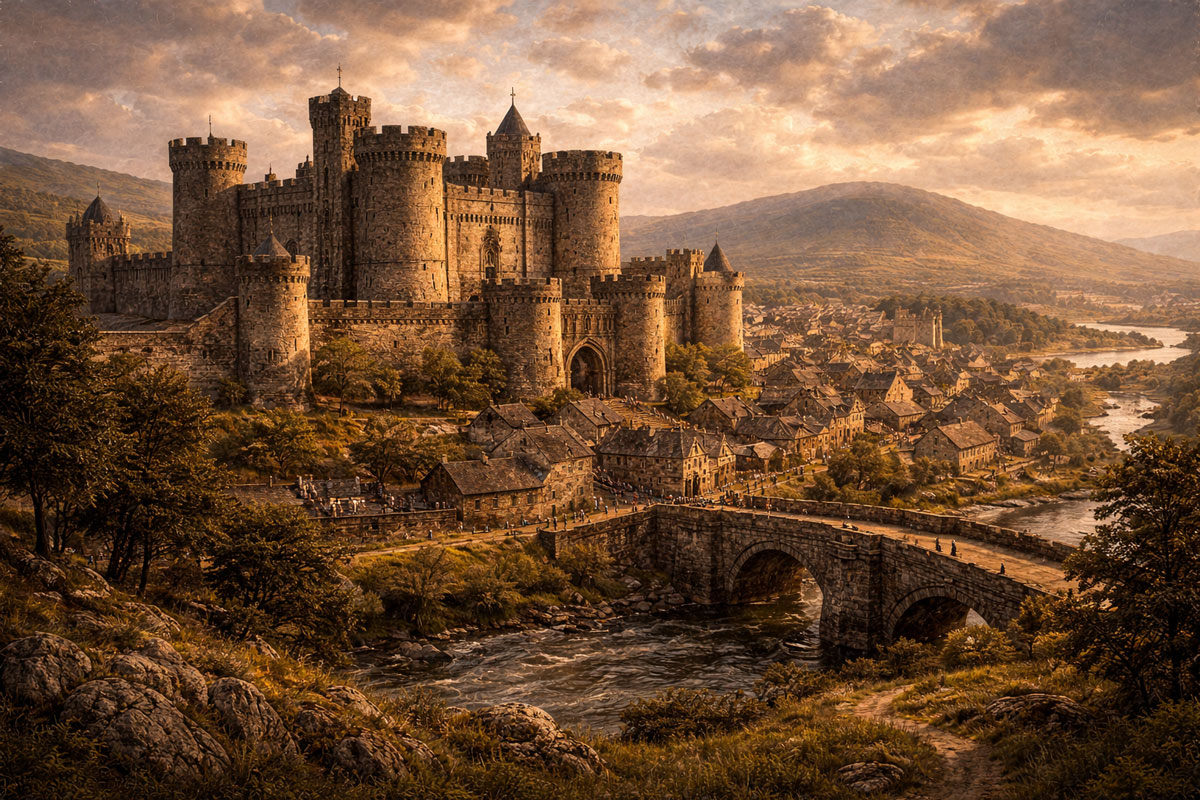
Perhaps the most visible Norman legacy is Ireland’s network of castles. Early fortifications were simple motte-and-bailey structures—wooden towers on raised earth mounds—but these were soon replaced by imposing stone keeps.
Castles such as Trim Castle in County Meath and Kilkenny Castle in County Kilkenny became symbols of authority and defense. These structures were not merely military installations; they functioned as administrative centers, residences, and symbols of dominance.
Stone curtain walls, gatehouses, and defensive towers altered Ireland’s architectural landscape. The shift from timber to stone represented permanence and control. Many Norman castles were strategically positioned near rivers, ports, and trade routes, reinforcing their role in economic as well as military life.
Today, these ruins remain among Ireland’s most striking medieval monuments—testament to a transformative era of building and consolidation.
The Rise of Medieval Towns
The Normans also played a pivotal role in the development of Irish towns. Before their arrival, Ireland had few urban centers in the continental sense, aside from earlier Viking settlements such as Dublin and Waterford.
Under Norman influence, towns were formally chartered and planned with streets, markets, and defensive walls. Kilkenny, Wexford, and Drogheda flourished as commercial hubs, linking Ireland more closely to England and continental Europe.
Market rights and guild systems encouraged trade in wool, hides, and agricultural goods. Ports expanded, and a merchant class began to emerge. These towns became centers of cultural exchange, where Gaelic and Norman populations interacted daily.
Stone churches and cathedrals also rose during this period, blending Romanesque and Gothic styles and reflecting Ireland’s integration into wider European artistic currents.
Cultural Exchange and Gaelic Revival
Although initially distinct from the native population, many Norman families gradually assimilated into Gaelic society. Over generations, they adopted Irish language, dress, and customs—a process famously described as becoming “more Irish than the Irish themselves.”
Intermarriage and alliance blurred cultural boundaries. Some Norman lords supported Gaelic poets and musicians, while Gaelic leaders adopted elements of Norman military organization.
However, tensions persisted. English authorities periodically attempted to reinforce separation between settlers and native Irish, most notably through the Statutes of Kilkenny in 1366, which sought to prevent cultural blending. Despite these efforts, hybrid identities continued to form.
By the late medieval period, Norman influence had both reshaped Ireland and been reshaped by it. The island’s political landscape became a mosaic of Gaelic lordships and Anglo-Norman territories.
The Norman Legacy in Modern Ireland
The Norman era left enduring marks on Ireland’s physical and social fabric. Castles, town layouts, and parish structures still define many communities today.
Place names across Ireland reflect Norman roots, and family surnames such as Fitzgerald, Burke, and Butler trace back to this period. The legal and administrative frameworks introduced during the Norman era influenced later English governance.
Architecturally, Norman churches, abbeys, and fortified houses remain key components of Ireland’s heritage tourism and scholarly study. They represent a chapter in which Ireland was deeply connected to continental Europe through trade, religion, and culture.
Yet the Norman story is not simply one of conquest. It is a story of adaptation, exchange, and transformation—where external influence met deeply rooted tradition, producing a uniquely Irish medieval identity.
Conclusion
The Norman arrival in Ireland marked a turning point in the island’s history. Through castles, towns, and evolving governance, the Normans reshaped the medieval landscape in lasting ways. At the same time, Ireland reshaped them, blending cultures and forging new identities.
Today, the stone ruins and town streets that remain stand as enduring reminders of this complex chapter—one that continues to shape Ireland’s heritage and sense of place.