



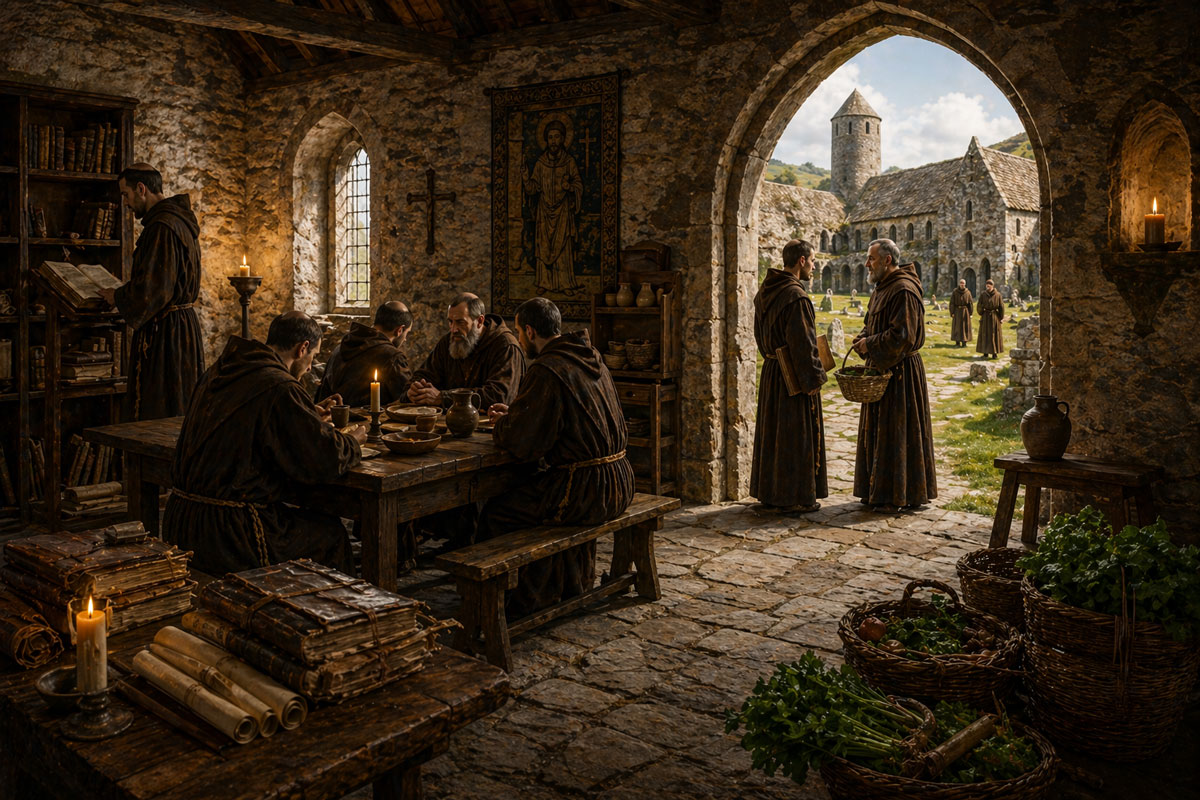

In early medieval Ireland, monasteries were more than places of prayer—they were centers of learning, craftsmanship, and community life. From the 6th to the 9th century, monks followed structured daily routines that balanced spiritual devotion with intellectual work. Within stone walls and quiet valleys, these communities preserved knowledge, shaped culture, and created a rhythm of life that has fascinated historians for centuries.
Table of Contents
- The Structure of Monastic Life
- Prayer and the Divine Office
- Work, Farming, and Self-Sufficiency
- Learning, Writing, and the Scriptorium
- Community Life and Discipline
The Structure of Monastic Life
Life in a medieval Irish monastery followed a strict and carefully ordered routine. Monks lived according to a rule—a set of spiritual and practical guidelines that governed daily life. While not identical across all monasteries, these rules emphasized obedience, humility, prayer, and work.
Monasteries were often self-contained settlements, with churches, living quarters, workshops, farmland, and sometimes defensive structures such as round towers. Located in remote valleys, coastal islands, or wooded landscapes, these sites were chosen for their isolation and natural beauty.
The day was divided into periods of prayer, labor, study, and rest. Time itself was structured around religious observance, creating a rhythm that aligned daily life with spiritual purpose.
For monks, every action—whether writing a manuscript or tending crops—was considered part of their devotion.
Prayer and the Divine Office
Prayer formed the foundation of monastic life. The day began before dawn and was structured around the Divine Office—a series of prayers recited at specific times throughout the day and night.
Monks gathered in the church for communal prayer, chanting psalms and reading from Scripture. These services could occur up to eight times a day, including during the night hours.
This constant return to prayer reinforced the idea that spiritual life was not separate from daily activity, but woven into every moment.
Silence was often observed between services, encouraging reflection and focus. Even outside formal prayer, monks were expected to maintain a contemplative mindset, turning their thoughts toward God throughout the day.
The discipline of repeated prayer created a sense of order and continuity that defined monastic life.
Work, Farming, and Self-Sufficiency
Despite their spiritual focus, monasteries were practical communities that required constant labor to survive. Monks engaged in farming, tending crops such as barley, oats, and vegetables, while also caring for livestock.
Fishing, gathering, and food preparation were essential tasks, particularly in remote locations where external supplies were limited. Tools were crafted and repaired within the monastery, reflecting a high degree of self-sufficiency.
Work was not seen as separate from prayer but as an extension of it. Physical labor was a form of discipline and humility, reinforcing the values of simplicity and service.
Each monk contributed according to ability. Some worked in the fields, others in kitchens or workshops, and skilled artisans produced metalwork, carvings, and religious objects.
This balance between spiritual and physical work was central to the monastic ideal.
Learning, Writing, and the Scriptorium
One of the most remarkable aspects of Irish monasteries was their commitment to learning. Monks were among the most educated individuals of their time, studying Scripture, theology, and classical texts.
The scriptorium—the room dedicated to writing—was the heart of intellectual life. Here, monks copied manuscripts by hand, preserving religious texts as well as works from ancient Rome and beyond.
This work required patience, skill, and intense concentration. Illuminated manuscripts, such as the Book of Kells, were created with intricate designs, vibrant colors, and symbolic imagery.
Writing was considered a sacred task. Each letter formed on the page was an act of devotion, combining faith with artistry.
Through their efforts, Irish monks played a crucial role in preserving knowledge during a period when many parts of Europe experienced cultural decline.
Community Life and Discipline
Monastic life was deeply communal. Monks lived, worked, and prayed together, forming close-knit communities bound by shared purpose.
Meals were simple and often eaten in silence while listening to readings. Diets typically consisted of bread, vegetables, dairy, and occasionally fish.
Discipline was strict. Rules governed behavior, speech, and even thought. Acts of disobedience could result in penance, such as fasting or additional labor.
Yet alongside discipline was a strong sense of mutual support. Monasteries offered stability in a world that could often be uncertain and fragmented.
They also served the wider community, providing education, hospitality, and spiritual guidance to those who lived nearby.
Conclusion
Life in a medieval Irish monastery was defined by balance—between prayer and work, solitude and community, discipline and devotion. Within these quiet settlements, monks created a way of life that nurtured both spiritual growth and intellectual achievement.
Through their daily routines, they preserved knowledge, produced remarkable works of art, and shaped the cultural identity of Ireland and beyond. Today, the ruins of monasteries across the Irish landscape stand as reminders of a time when faith and learning were inseparable, and when the rhythm of daily life was guided by a higher purpose.