



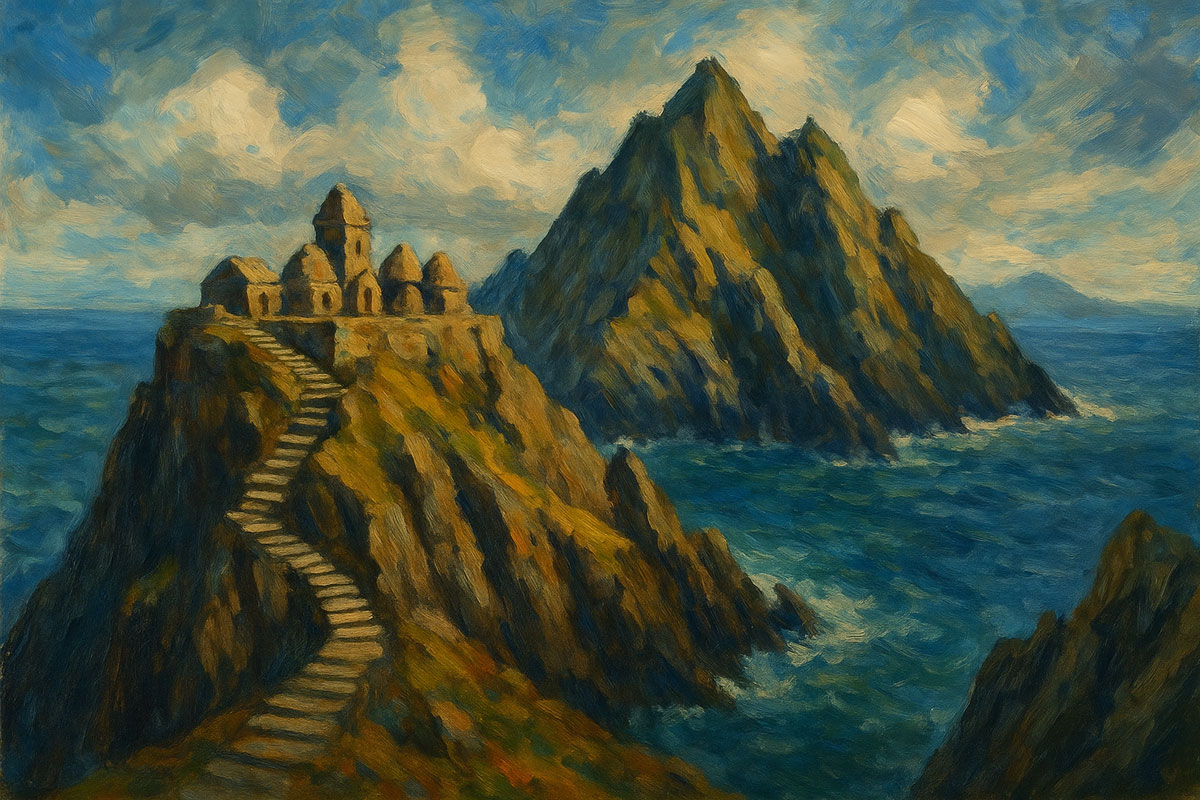

Rising dramatically from the Atlantic Ocean off the coast of County Kerry, Skellig Michael is one of Ireland’s most iconic landmarks. Famous for its ancient monastic settlement and more recently for its role in the Star Wars films, this UNESCO World Heritage Site blends spiritual heritage, natural wonder, and pop culture.
Table of Contents
- The Monastic Origins of Skellig Michael
- A Harsh Yet Holy Landscape
- Wildlife and Conservation Efforts
- From Hidden Gem to Star Wars Icon
The Monastic Origins of Skellig Michael
Skellig Michael, also known as Great Skellig, is a rocky island located about 12 kilometers off the Iveragh Peninsula in southwest Ireland. Its most remarkable feature is the monastic settlement that clings to its steep slopes, built by early Christian monks in the 6th century. These monks sought out remote and inhospitable places where they could devote themselves fully to prayer, contemplation, and a life apart from worldly distractions. For them, Skellig Michael was the ultimate retreat – an isolated rock at the edge of the known world.
The Arrival of the Monks
Historical records are scarce, but it is believed that monks established their community on Skellig Michael sometime between the 6th and 8th centuries. The choice of location reflected the early Irish monastic tradition of seeking “deserts in the ocean,” where isolation and hardship were seen as pathways to spiritual purity. To reach their new home, the monks would have braved unpredictable seas in small wooden boats, landing on narrow rock ledges before ascending hundreds of stone steps carved into the cliffs.
The Monastic Settlement
At the heart of the settlement are a group of beehive-shaped stone huts, known as clocháns, built without mortar and remarkably well-preserved. These huts provided shelter against the harsh Atlantic winds and rains. Alongside them are oratories, small churches, stone crosses, and terraces used for prayer and simple agriculture. Rainwater was collected in cisterns, and the monks survived by fishing, keeping bees, and growing limited crops on terraced plots of soil carried up from the mainland.
Life of Prayer and Hardship
Life on Skellig Michael was not easy. The monks endured fierce storms, limited food supplies, and the constant challenge of survival in such a harsh environment. Yet, their dedication was unwavering. Their daily routine centered on prayer, scripture, and contemplation, echoing the broader Irish monastic movement that produced great centers of learning and spirituality. Unlike places such as Clonmacnoise or Glendalough, however, Skellig Michael represented the extreme of ascetic living – a true desert of the sea.
Skellig Michael in Irish Christianity
The monastery on Skellig Michael reflects the deep spiritual traditions of early Ireland. The monks’ commitment to isolation and devotion symbolizes the intensity of early Irish Christianity, where faith was often lived on the very edges of the world. Over time, the site became part of Ireland’s ecclesiastical network, though its remoteness meant it remained a small community. By the 12th or 13th century, as conditions on the island grew increasingly difficult and the Church’s structures shifted, the monks eventually moved to the mainland.
Legacy of the Monks
Though abandoned as a monastic community, the stone huts, oratories, and stairways remain as silent witnesses to the monks’ endurance and devotion. Today, these remains form one of the best-preserved examples of early medieval monastic architecture in Europe. Recognized by UNESCO in 1996, Skellig Michael stands as a testament to the spiritual and cultural legacy of early Ireland, where faith and nature met in one of the world’s most dramatic settings.
A Harsh Yet Holy Landscape
Skellig Michael is more than a historic site – it is a dramatic natural wonder. Rising nearly 218 meters (715 feet) above sea level, the island is a jagged pyramid of rock that seems to emerge suddenly from the Atlantic. Its stark cliffs, crashing waves, and windswept slopes create an environment that is both beautiful and forbidding. For the monks who chose this remote retreat, the harshness of the landscape was not a deterrent but rather an essential part of their spiritual journey.
The Island’s Geography
Skellig Michael consists of two main peaks connected by a thin ridge known as “Christ’s Saddle.” The monastic settlement is located on a terrace high on the northern peak, perched some 180 meters above sea level. The climb to the top requires navigating over 600 ancient stone steps, each hand-carved into the rock by the monks themselves. These stairways are still in use today, guiding visitors up the same path trodden by monks more than a thousand years ago.
Isolation and the Ocean
One of the defining characteristics of Skellig Michael is its extreme isolation. Situated 12 kilometers offshore, it is accessible only by boat on calm days. The Atlantic swells can make landings treacherous, and storms often cut the island off for weeks at a time. For the monks, this isolation reinforced the sense of separation from the world – a place where they could be closer to God. For modern visitors, the journey by sea heightens the sense of adventure and awe.
Natural Challenges
The climate of Skellig Michael is unforgiving. Heavy rain, strong winds, and salt spray are constant. Food could not be grown in abundance, and fresh water had to be carefully collected and stored. The monks used cisterns carved into rock to gather rainwater, and terraced plots of soil were brought from the mainland to allow limited cultivation. Every aspect of life was shaped by the need to adapt to this harsh environment, making survival itself an act of devotion.
The Stone Steps and Architecture
The network of stairways leading to the summit is among the island’s most striking features. These steps, some narrow and uneven, wind their way up sheer cliffs with no modern handrails or supports. They symbolize the monks’ journey toward spiritual ascent – each step a movement closer to heaven. The craftsmanship is remarkable, and the fact that they remain intact after centuries of storms testifies to both the skill and faith of their builders.
The View from the Summit
Standing atop Skellig Michael offers one of the most awe-inspiring views in Ireland. To the east, the Kerry coastline stretches along the Wild Atlantic Way; to the west, the open ocean extends endlessly. For the monks, this view represented both physical isolation and spiritual elevation. For modern visitors, it is a breathtaking reminder of Ireland’s wild beauty and the resilience of those who once lived on this remote rock.
Why the Landscape Matters
The landscape of Skellig Michael is inseparable from its spiritual and cultural significance. The island’s steep cliffs, perilous steps, and storm-battered isolation shaped the daily life of the monks and amplified their devotion. Today, the same dramatic features inspire a sense of wonder in all who visit. Skellig Michael’s landscape is not just a backdrop – it is an integral part of its identity, blending natural drama with human determination.
Wildlife and Conservation Efforts
While Skellig Michael is renowned for its monastic heritage, it is also a sanctuary for wildlife. The island’s cliffs and slopes provide nesting grounds for thousands of seabirds, while the surrounding waters teem with marine life. This combination of cultural and natural importance makes Skellig Michael not only a UNESCO World Heritage Site but also a vital ecological treasure.
Seabird Colonies
Skellig Michael is home to some of the largest seabird colonies in Ireland. Puffins, with their colorful beaks and comical expressions, are among the island’s most beloved residents, arriving each spring to nest in burrows on the grassy slopes. Gannets, kittiwakes, razorbills, and storm petrels also thrive here, filling the skies with their cries and activity. For birdwatchers, the island is a paradise, offering rare glimpses of species that rely on such remote places to breed undisturbed.
Marine Life Around the Island
The waters surrounding Skellig Michael are rich in biodiversity. Dolphins, porpoises, and even minke whales are often sighted during the boat journey to the island. Grey seals bask on nearby rocks, adding to the sense of wildness. The Atlantic currents bring an abundance of fish, which sustain both the seabird populations and local fisheries, creating an intricate web of life connected to the island’s ecosystem.
Fragile Ecosystem
Despite its rugged appearance, the island’s ecosystem is fragile. The steep slopes are vulnerable to erosion, and the seabird populations depend on the delicate balance of marine resources. Climate change, overfishing, and human activity pose potential threats. Because of this, careful conservation management is essential to safeguard Skellig Michael for future generations.
UNESCO World Heritage Recognition
In 1996, Skellig Michael was designated a UNESCO World Heritage Site, recognized for its outstanding cultural and natural value. This recognition not only highlights its monastic heritage but also its role as a critical wildlife sanctuary. The dual significance of Skellig Michael – as both a human and natural landmark – makes it unique among heritage sites worldwide.
Conservation Efforts
The Irish government and conservation organizations have worked to balance access to the island with the need to protect its environment. Visitor numbers are strictly limited, and access is often restricted during breeding seasons or rough weather to minimize disturbance. Restoration of the monastic structures has been carried out with great care, ensuring that preservation does not harm the surrounding habitats. These efforts reflect a commitment to ensuring that Skellig Michael remains both a cultural monument and a thriving ecosystem.
Why Wildlife Matters Here
The wildlife of Skellig Michael adds a vital dimension to its identity. The monks who once lived here would have shared the island with the same seabirds that nest today, and their survival depended in part on the rich marine life. For modern visitors, witnessing puffins in flight or dolphins in the waves adds to the magic of the journey. Protecting these creatures ensures that the island continues to inspire awe – not just for its human history but also for its living beauty.
From Hidden Gem to Star Wars Icon
For centuries, Skellig Michael was known primarily to historians, archaeologists, and adventurous travelers who braved the Atlantic to experience its solitude. But in recent years, the island has captured the imagination of millions around the world, thanks to its role as a filming location for the Star Wars sequel trilogy. This unexpected chapter in its history has transformed Skellig Michael into a global cultural icon while raising new questions about heritage, tourism, and preservation.
Skellig Michael in Popular Culture
The unique beauty of Skellig Michael has long inspired artists and writers. Its remote, otherworldly appearance made it a natural fit for filmmakers seeking a location that evoked mystery and timelessness. Few, however, could have predicted the worldwide attention it would receive when it was chosen as the site of Luke Skywalker’s refuge in Star Wars: The Force Awakens (2015) and The Last Jedi (2017).
The Star Wars Connection
In the films, Skellig Michael stands in for the planet Ahch-To, the birthplace of the Jedi Order. Its jagged cliffs, stone steps, and ancient huts provided the perfect backdrop for scenes that blended fantasy with an authentic sense of ancient mystery. Audiences were struck by the stark realism of the setting, which required little digital alteration. The island itself became a character in the story – a place of exile, reflection, and rediscovery.
Tourism Boom
Following the release of the films, visitor interest in Skellig Michael surged. Fans from around the world traveled to County Kerry hoping to climb the same steps as Luke Skywalker and Rey. Local tourism saw a dramatic increase, with boat trips to the island in even higher demand. While this boost has been welcomed by the region’s economy, it has also required careful management to prevent damage to the fragile site.
Balancing Fame and Preservation
The Star Wars spotlight brought both opportunities and challenges. Increased visitor numbers raised concerns about erosion, disturbance to seabird colonies, and strain on the ancient stonework. In response, strict visitor limits remain in place, and trips are weather-dependent to ensure safety. Heritage and conservation authorities continue to emphasize that Skellig Michael is first and foremost a sacred historical site and fragile ecosystem, not simply a film set.
A Place Beyond the Screen
For many visitors, the Star Wars connection serves as an introduction to Skellig Michael’s deeper significance. Standing among the beehive huts or gazing across the Atlantic, travelers often discover that the island’s real history and spiritual legacy far surpass its fictional fame. The blending of pop culture and heritage has created a rare opportunity to connect global audiences with Ireland’s past in a meaningful way.
Skellig Michael’s Enduring Appeal
From a monastic retreat at the edge of the known world to a UNESCO World Heritage Site and global cinematic icon, Skellig Michael embodies the meeting of history, nature, and imagination. Its steep steps and stone huts tell of ancient devotion, its seabirds and marine life speak to the resilience of nature, and its role in film introduces a new generation to its wonder. Skellig Michael is proof that some places transcend time, inspiring awe in all who encounter them – whether through history, pilgrimage, or cinema.
Conclusion: Skellig Michael is a site where worlds converge – the spiritual world of the monks, the natural world of seabirds and seas, and the imaginative world of film. Its legacy continues to grow, reminding us that Ireland’s heritage is not only about preserving the past but also about inspiring the future. For those who visit, the journey to Skellig Michael is more than a trip; it is an encounter with the extraordinary.